
Lenovo has delivered the first of five supercomputers to Petrobras under a contract signed between the companies in 2024, worth 500 million reais (US$93.1m).
Petrobras announced plans to invest $89m to acquire five new Lenovo supercomputers in September 2024. Lenovo's bid reportedly beat out the bids submitted by Dell (606 million reais) and Atos (556 million reais).
This contract marks Lenovo's first partnership with Petrobras in the area of supercomputing.
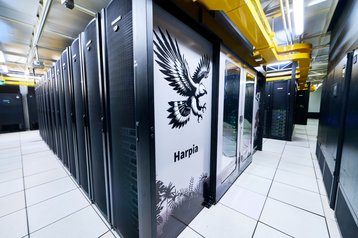
The 146 petaflops Harpia - the first of the five supercomputers included in the contract - is now up and running. With an estimated value of 435 million reais, it is the largest machine in the set and, according to Petrobras, its implementation should increase the company's computing capacity by more than 60 percent.
Once the installation is complete, Harpia will fully take over the functions of the Fénix, Atlas, and Dragão supercomputers, which will be decommissioned.
Harpia weighs around 50 tons and measures approximately 50 meters in length, considering all its aligned parts.
The supercomputer will be used by Petrobras geophysicists to process raw seismic data in order to generate detailed images of the subsoil.
This process allows for the construction of three-dimensional representations of the rock formations below the surface, offering greater clarity and precision in the visualization of geological structures. These images are essential for identifying petroleum systems and potential areas for oil and gas exploration, as Petrobras' director of exploration and production, Sylvia Anjos, said in an official statement.
The other supercomputers, including the Ada Lovelace, aimed at geostatistical applications, and the Capivara, aimed at processing seismic images, are also in operation at the Petrobras Research Center (Cenpes) data center.
The Quati machine is in the testing phase and is expected to start operating later this month, also focusing on seismic analysis.
Tupã 2, which is scheduled to be launched in the first quarter of 2026, will be dedicated to multiphysics geophysical methods - technology that allows for the simultaneous analysis of different characteristics of underground rocks and fluids, such as density and electrical resistance, according to Petrobras.
In March 2023, Petrobras deployed its first AI supercomputer, Tatu, comprising 224 Nvidia GPUs with 80GB of memory distributed across 11 racks. Previous reports suggested Atos had won a bid for another AI supercomputer.
In March 2025, Petrobras launched a tender for data processing and storage capabilities, inviting bids from data center colocation firms to host equipment for critical applications and high-performance computing systems. Local operator Elea won the contract.





Comments