
Malaysian telco U Mobile has secured a financing facility worth RM4.3 billion ($1bn) to fund the expansion of its 5G network.
U Mobile is notably building out Malaysia's second 5G network, rivaling Digital Nasional Bhd's (DNB) 5G network.
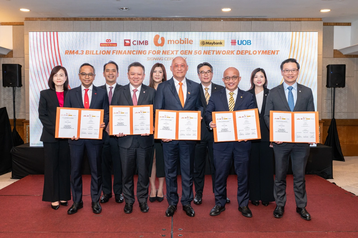
U Mobile launched its 5G network in August, initially pushing the service live at Berjaya Times Square (BTS), which includes U Mobile's headquarters, a shopping mall, a hotel, and an indoor theme park.
To support the carrier's 5G expansion plans, U Mobile has secured the $1bn financing with a number of banks.
CIMB Investment Bank Berhad is the sole loan coordinator, joint mandated lead arranger, and CIMB Bank Berhad and CIMB Islamic Bank Berhad are the financiers.
The financing was supported by Maybank Islamic Bank Berhad, AmBank Islamic Bank Berhad, and UOB Malaysia, which served as joint mandated lead arrangers and financiers.
According to U Mobile, the financing will mainly fund its capex and working capital for its 5G network deployment. The carrier has goals to reach 80 percent of Malaysia's population by the second half of 2026.
“Our 5G deployment across Malaysia started in the middle of 2025, and this new facility will further accelerate our rollout ambitions and reinforce our commitment to drive Malaysia's digital economy,” said Wong Heang Tuck, chief executive officer of U Mobile.
Earlier this year, U Mobile chairman Tan Sri Vincent Tan Chee Yioun outlined plans to complete the 5G network rollout by mid-2026. He noted at the time that the company would not need any additional backing from the government or new partners.
The carrier chose Chinese vendors Huawei and ZTE as technology partners for its 5G network. Nordic rival Ericsson supported DNB's state-owned 5G rollout.
A second network was proposed by the government as it sought to end the duopoly held by Digital Nasional Bhd (DNB). The government approved it last year.
Launched in 2021, DNB has seen its network heavily scrutinized by Prime Minister Ibrahim's administration over claims of transparency issues. This led Ibrahim's administration to review DNB's plan for a state-owned 5G network, with DNB quite clear that it was to be the only 5G network in the country.






Comments