
Rocket company SpaceX has filed plans with the FCC for up to one million 'orbital data center' satellites.
The Elon Musk company said that it would "operate a constellation of satellites with unprecedented computing capacity to power advanced artificial intelligence (AI) models and the applications that rely on them."
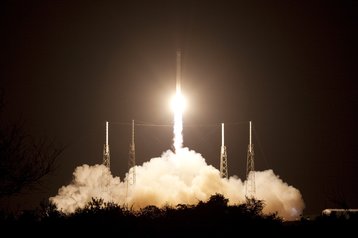
The satellites are planned to operate between 500km and 2,000km altitude, and 30 degrees and Sun-synchronous orbit inclinations.
Different clusters will operate at 50km intervals, potentially geared towards different workload and latency demands.
The company's existing constellation of Starlink satellites, which provide Internet from space, operated at around 550km, but are being lowered to 480km this year for faster deorbiting and lower latency.
More than 9,500 Starlink satellites have been launched (with 8,000 functioning), while the company has plans to eventually deploy a network of more than 40,000.
The proposed 'SpaceX Orbital Data Center System' will connect to Starlink via high-bandwidth optical links, with Starlink then connecting by laser mesh down to ground stations.
Current Starlink satellites sport three lasers operating up to 200Gbps, with an upcoming generation set to support 1Tbps.
However, after rival Blue Origin announced a data center-focused optical communications satellite system, TeraWave, that supports up to 6Tbps, Musk claimed that future "Starlink space to ground laser links will exceed this."
The SpaceX data center satellites will also use slower Ka-band communications equipment for telemetry, tracking, and command.
“Orbital data centers are the most efficient way to meet the accelerating demand for AI computing power,” the filing said, noting the rising power demands of terrestrial facilities.
"Launching a constellation of a million satellites that operate as orbital data centers is a first step towards becoming a Kardashev II-level civilization – one that can harness the Sun's full power – while supporting AI-driven applications for billions of people today and ensuring humanity's multi-planetary future is among the stars."
Depending on the orbital plane, the system is expected to remain solar-powered for more than 99 percent of its operations, minimizing the need for batteries or other systems. Those with more sunlight are proposed for workloads requiring constant compute, while lower-inclination orbits would handle peaks in demand.
The data centers will use radiative cooling, and are expected to have an operational life of five years.

How this feature got to the Moon
And what it means for the future of digital infrastructure, humanity, and what we will leave behind
SpaceX points to the delayed Starship rocket as critical for lowering the cost of bringing compute to orbit (it also allows the satellites to be much larger).
The company claims that, once Starship is operational and reusable, "launching one million tonnes per year of satellites generating 100kW of computer power per tonne would add 100 gigawatts of AI compute capacity annually, with minimal ongoing operational or maintenance needs.
"Freed from the constraints of terrestrial deployment, within a few years the lowest cost to generate AI compute will be space."
No specific timelines were shared. SpaceX requested a waiver of FCC milestone requirements that usually require half of a constellation to be deployed within six years of authorization and the full system within nine years.
Starship's next test launch is expected by March – last year saw five launches, with the first three ending in explosions. The final two tests of 2025 successfully reached orbit, and deployed fake satellites, but did not test reusability for either stage, a key criterion for reducing launch costs.
SpaceX last year said that it was targeting launching its third-generation satellites in the first half of 2026, which require Starship, although the company is known to miss timelines.
The company also plans to go public this year, with a valuation north of a trillion dollars. Musk has said that funds from the IPO are expected to help cover its orbital data center ambitions.
At the same time, SpaceX is reportedly in talks to merge with xAI, Musk's generative AI and social media company that has built several large ground-based data centers (which have a habit of polluting the air). SpaceX has also discussed merging with Musk's public car company, Tesla.
The orbital data center proposal has no guarantee of being approved, and would mark a dramatic increase on the roughly 14,000 active satellites in orbit today (many of which are Starlink).
Last year, SpaceX requested approval for some 22,000 next generation Starlink systems, and was granted a partial license for 7,500. This gives it a current max capacity of 19,400 satellites in orbit.
While China has filed with the ITU for two megaconstellations totalling 200,000 satellites, it is believed those proposals are more about securing orbital planes and spectrum for potential future projects.
A million satellite proposal is by far the largest potential megaconstellation to reach filing stage. However, it is important to note that the filing was particularly light on details, including on mass or hardware. Musk's businesses also have a history of bullish promises, many of which are delayed or replaced with new promises.
A number of companies plan to deploy data centers in space, including Axiom Space, NTT, Ramon.Space, Aetherflux, and Sophia Space, to name but a few.
Starcloud (previously Lumen Orbit) successfully launched a single GPU into space as a test.
Jeff Bezos, Amazon's founder and the owner of Blue Origin, said that there will be gigawatt data centers in space in 10+ years, while former Google CEO Eric Schmidt said that he acquired rocket company Relativity Space to put data centers in orbit.
Late last year, Google announced 'Project Suncatcher,' a plan to partner with Planet for TPUs in space. The company is still in the early test stages, but said that it could theoretically scale to terawatts of compute in space.
Assuming Starship achieves reusability, and then increases in launch cadence and consistently reduces launch costs, Google predicted that launching data centers to space will become cheaper than terrestrial operations (thanks to free power and cooling) by 2035.

Comments