
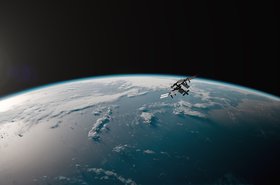
Google plans to launch TPU AI chips into space.
The company will partner with Planet Labs on 'Project Suncatcher,' which will initially see two satellites launch by early 2027 to explore the potential of larger-scale space data center clusters.
"Like any moonshot, it’s going to require us to solve a lot of complex engineering challenges," Google CEO Sundar Pichai said.

"Early research shows our Trillium-generation TPUs (our tensor processing units, purpose-built for AI) survived without damage when tested in a particle accelerator to simulate low-earth orbit levels of radiation. However, significant challenges still remain, like thermal management and on-orbit system reliability."
As part of its research, Google published a pre-print paper on Project Suncatcher that laid out its hopes for the effort, with the company theorizing "a scalable compute system for machine learning in space, using fleets of satellites equipped with solar arrays, inter-satellite links using free-space optics, and Google tensor processing unit (TPU) accelerator chips."
The paper lays out the basics for a potential 81-satellite cluster of 1km radius, but notes that significant technical and logistical hurdles still exist, and that the final scale could change.
This Sunday saw the launch of the Starcloud-1 satellite featuring an Nvidia H100, with startup Starcloud proposing to one day build a 5GW data center across a 4km solar array.
"Proposals exist for “monolithic” data centers in space where individual spacecraft significantly exceed the size of any current or planned launch vehicle," Google said in its paper, linking to Starcloud's whitepaper.
"While such design concepts reduce the need for high-performance inter-satellite links, they involve new challenges: such structures would have to be assembled in space by humans or robots; collision avoidance would be more cumbersome; and structural requirements would add mass and complexity."
Instead, Google proposes deploying arrays of smaller modular satellites in close flight proximity that "would provide ample opportunity to scale to the terawatts of compute capacity that could fit within the dawndusk sun-synchronous low-earth orbital band."
One of the challenges of such a disaggregated approach will be networking – Google's terrestrial data centers use both pod-level connectivity and a custom, low-latency optical Inter-Chip Interconnect (ICI) supporting hundreds of gigabits per second per chip.
Current inter-satellite link connectivity, meanwhile, support data rates of 1–100Gbps. Google analysis found that the required 10Tbps aggregate bandwidth per link is achievable with Commercial Off-The-Shelf (COTS) Dense Wavelength Division Multiplexing (DWDM) transceiver technology, but it requires significantly higher received optical power levels than the traditional satellite approach.
That's where the close formation of the satellites comes into play – by flying within hundreds of kilometers or less, that power level drops significantly. Additionally, the "smaller beam spot size at shorter distances allows multiple independent beams to be established between transceiver arrays on different satellites, each carrying a separate DWDM datastream."
To do this would require operating satellites in a tighter formation than any current or previous satellite constellation, with a predicted mean cluster altitude of 650km.
Next on Google's list of potential problems for data centers in space is the challenge of space radiation. The company tested its TPU (along with an AMD CPU in a server) on a 67 MeV proton beam, protected by the level of shielding it expects to able to send to space.
While the chips survived the test, which was aimed at simulating five years of penetrating protons and Galactic Cosmic Rays, Google said that High Bandwidth Memory (HBM) subsystems exhibited the most sensitivity to Total Ionizing Dose (TID) effects.
HBM suffered some uncorrectable errors, at a rate that Google said was "likely acceptable for inference." However, the impact of Single Event Effects (SEEs), instantaneous faults caused by a single energetic particle strike generating a dense track of electron-hole pairs, on training runs "requires further studying."
Next are launch costs and power. While costs go from $1,500-$2,900/kg (or more depending on the launch requirements), they would have to drop substantially for Suncatcher to work.

How this feature got to the Moon
And what it means for the future of digital infrastructure, humanity, and what we will leave behind
Given an estimated US data center power cost of ∼$570–3,000/kW/y, Google said that "if launch costs to LEO reach $200/kg, then the cost of launch amortized over spacecraft lifetime could be roughly comparable to data center energy costs, on a per kW basis."
This launch cost could be hit in 2035, Google theorized, should SpaceX's Starship launch soon – and then launch 180 times per year. However, by 2035 the power cost of terrestrial data centers will also have changed.
For cooling, Google notes that "advanced thermal interface materials and heat transport mechanisms" would be required, "preferably passive to maximize reliability ... to efficiently move large heat loads from the chips to dedicated radiator surfaces."
As for failures, with humans unable to replace TPUs that break like they do in data centers here, "the simplest solution is redundant provisioning."
The project is still in the earliest stages, led by senior director Travis Beals.
This past week, billionaire Elon Musk said that SpaceX "will be doing" data centers in space.
Jeff Bezos, Amazon's founder and the owner of Blue Origin, last month said that there will be gigawatt data centers in space in 10+ years, while former Google CEO Eric Schmidt this year said that he acquired rocket company Relativity Space to put data centers in orbit.
A number of companies plan to deploy data centers in space, including Axiom Space, NTT, Ramon.Space, and Sophia Space, to name but a few.



Comments