
Another space startup looking to launch orbital data centers has secured funding.
Seattle-based Sophia Space, an orbital computing venture, has raised $3.5 million in pre-seed funding led by Unlock Ventures with the participation of angel investors, to develop Edge compute solutions for orbit and what they call space-based data centers.
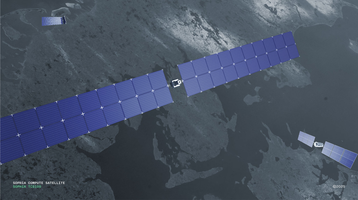
“We are at the dawn of a new era where our demand for AI technology should not come at the expense of our planetary health due to energy constraints,” Leon Alkalai, company co-founder and chairman, said in a statement.
Alkalai is an ex-NASA Jet Propulsion Laboratory fellow, and is joined by Intel and Microsoft veteran Brian Monnin as chief growth officer. Monnin also founded Seattle tech startups Play Impossible and Quivr.
The company’s signature technology is the TILE platform, a computing unit optimized for the use of AI technologies, commercial space stations, and defense systems. TILEs feature solid-state, self-sustaining compute modules that offer radiation-resistant, vendor-agnostic performance.
“Our modular Sophia TILEs unlock a future of scalable, energy-efficient, orbital compute infrastructure, from satellites and space stations to full-scale orbital data centers that will augment terrestrial data centers in the future. Doing so will help civil, defense, and commercial customers grow more rapidly without drawing from local energy grids or water supplies as is the case now,” Alkalai added.
Sophia claims TILE Edge servers aren’t adapted from terrestrial solutions, instead built deliberately for space, configured with either Qualcomm SnapDragon 865 and Cloud 100, or Nvidia Jetson and Blackwell, each with its own dedicated solar panel.
Orbital data centers?
Orbital Edge computing is prized for its ability to address data congestion in satellites, which are producing more types and quantities of data at higher fidelities than ever before. Every bit of downstream information drawn from satellites takes significant resources to tap, which makes pre-processing at the Edge invaluable for filtering out the highest-quality data to send back to Earth.
It’s a problem that will only get more pertinent as governments and militaries demand ever more comprehensive monitoring and imaging systems in orbit in order to stay ahead of a race toward space intelligence capacity in a climate of rising geopolitical tensions.
Companies including Axiom Space, Starcloud (previously Lumen Orbit), NTT, Lonestar, Ramon.Space, and Jeff Bezos's Blue Origin are looking at deploying in-orbit compute.
Sophia Space draws attention to the weaknesses of terrestrial data centers in their susceptibility to grid power, large footprint, and thermal considerations, all of which it proposes would be absent in space, given the ready access of solar power, low land use, and extreme cold of space, respectively.
Unfortunately, the inaccessibility of satellites for maintenance and cybersecurity, their great cost compared to ordinary buildings, and the dangers of LEO orbits dampen these arguments. That is to say nothing of the extreme heat satellites can be exposed to in space, and the long periods they spend in darkness when they orbit the dark side of the planet.
Sophia Space did not immediately respond to requests for comment.




Comments