
SpaceX will deploy data centers in space, CEO Elon Musk has claimed.
Musk said that the company’s next-generation V3 Starlink satellites could serve as a foundation for eventual data centers by being scaled up.
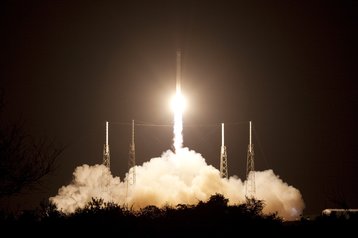
Responding on X to an article about autonomous assembly for space data center construction, he said: “Simply scaling up Starlink V3 satellites, which have high speed laser links would work. SpaceX will be doing this.”
The larger V3 satellites are set to provide gigabit-class Internet speeds, but require Starship to launch, SpaceX's still-in-prototype new rocket. Dozens are expected to be launched with each Starship, with the company optimistically targeting an early 2026 start.
What 'scaling up' the V3 means, and when it becomes a data center, is unclear.
Speaking more broadly on the solar capacity that could be sent into space, Musk said: "Starship could deliver 100GW/year to high Earth orbit within four to five years if we can solve the other parts of the equation.
"100TW/year is possible from a lunar base producing solar-powered AI satellites locally and accelerating them to escape velocity with a mass driver."
It is worth noting that Musk has a history of making grandiose promises and missing timelines by years. Sometimes products are scaled back significantly at launch, or never released.
Musk's pitch follows similar comments by fellow billionaires and rocket owners Jeff Bezos and Eric Schmidt.
Bezos, Amazon's founder and the owner of Blue Origin, last month said that there will be gigawatt data centers in space in 10+ years, while former Google CEO Eric Schmidt this year said that he acquired rocket company Relativity Space to put data centers in orbit.
A number of companies plan to deploy data centers in space, including Axiom Space, Starcloud (previously Lumen Orbit), NTT, Ramon.Space, and Sophia Space, to name but a few.






Comments