
Senegalese telecoms firm Sonatel has deployed satellite ground station infrastructure to support Eutelsat’s OneWeb satellite fleet.
Sonatel recently announced that it has deployed an Eutelsat OneWeb Satellite Network Portal (SNP) at its teleport in Gandoul.
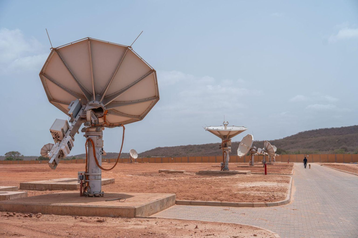
The deployment features 16 satellite antennas on 5 hectares.
“With the deployment of this Eutelsat OneWeb Gateway and its 16 next-generation satellite antennas, Sonatel is strengthening its historical teleport and confirming its commitment to long-term investment in high-level digital infrastructure serving Senegal and Africa,” said Brelotte Ba, CEO of Sonatel.
OneWeb has dozens of ground station sites live globally to serve its low Earth orbit (LEO) fleet, which totals some 600 satellites. At the same time, Eutelsat has a large portfolio of its own ground stations for its geostationary fleet.
Eutelsat was set to carve out its ground station infrastructure into a separate company after signing an $831m sale-leaseback deal with EQT, but the French government blocked the deal earlier this year.
“Africa is experiencing unprecedented digital momentum. Investments are accelerating, needs are exploding, and new connectivity routes—via submarine cables, terrestrial fiber, and satellites—are emerging rapidly,” Michaël Trabbia, CEO of Orange Wholesale, said on LinkedIn. “Gandoul embodies this transition: it preserves our heritage while building the connectivity of tomorrow, fostering strategic autonomy, resilience, and competitiveness in the era of New Space.”
The Gandoul site dates back to the early 1970s and was home to Africa’s first ground station. It was opened by the state-owned company that would eventually become Sonatel. Orange owns a significant minority stake in the telco.
SES has previously placed an O3b mPOWER ground station at Sonatel’s Gandoul teleport. The site was SES’s first O3b mPOWER ground station in Africa.
“The inauguration of the Gandoul Gateway marks a significant milestone in our long-standing partnership with Sonatel,” added Philippe Baudrier, managing director of Pan-African ISP, Konnect Africa.
Bell deploys ground station for AST SpaceMobile

Canadian telco Bell this week announced the completion of construction of its first sovereign direct-to-device satellite ground station, located in Québec, that is set to connect with AST SpaceMobile’s direct-to-cell satellites.
Testing has begun at the facility, and once operational, it will form part of the Canadian infrastructure supporting direct-to-device satellite services.
Construction of additional ground stations is underway in Ontario, Alberta, Newfoundland, and Labrador.
"The satellite ground infrastructure we’re building is designed to support a full suite of direct-to-device capabilities, including messaging, data connectivity, voice calling, and video streaming, helping extend connectivity to remote and underserved areas,” said Mark McDonald, Bell EVP and CTO.
“Bell Together with Bell’s world-class wireless network, it will help keep customers connected wherever they live, work and travel."
Bell invested in AST in 2021 through the telco’s Bell Ventures arm. The pair completed a space-based direct-to-cell 4G voice over LTE (VoLTE) call, broadband data, and video streaming test last year.
Chris Ivory, AST SpaceMobile chief commercial officer, added: “Canada’s vast and diverse geography presents a unique need to extend cellular broadband beyond the reach of traditional terrestrial infrastructure.
"Bell’s continued investment in their mobile network, combined with AST SpaceMobile’s unique space-based cellular broadband technology, will extend coverage beyond the reach of traditional terrestrial networks and deliver a seamless connectivity experience on everyday smartphones everywhere, anytime.”
New Zealand telco 2degrees is also building out ground stations to support direct-to-cell services via AST SpaceMobile.
Amazon signs satellite deal in South Africa
Amazon this week announced its Amazon Leo satellite service is partnering with South Africa's largest fixed Internet service provider, Herotel.
Herotel will use Amazon’s satellite to provide homes and small businesses with connectivity where fiber and fixed wireless services aren’t available. Herotel’s satellite offering will be called Evry and is due to launch in 2027.
Amazon said this is the company’s first deal of this type in Africa.
Herotel currently serves more than 350,000 active customers across more than 550 towns through fiber and fixed wireless networks.








Comments