
Space startup Muon Space has revealed plans for a new satellite design catering to orbital data centers.
The company recently announced Condor-Ultra, described as a “Starship-Class Spacecraft Platform” to provide “thermal and networking architecture to meet the demands of orbital data centers,” slating its pathfinder mission for delivery in 2028.
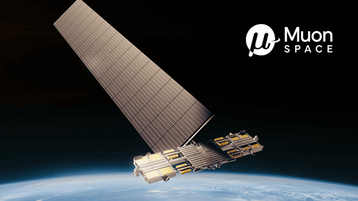
“The most compelling space infrastructure missions of the next decade – from global communications networks to scaled remote sensing to distributed orbital compute – require a managed and integrated platform that is powerful, stackable, and built to scale cost-effectively,” said Jonny Dyer, CEO of Muon Space, in a statement.
Condor-Ultra supports a customer payload serving its “power, aperture, and data requirements” by supplying 20kW power, 25Gbps of connectivity through Starlink, and 18 sqm of nadir payload area, supporting a payload weight of 400kg, capable of serving “constellations of hundreds to thousands of satellites."
Muon describes Condor-Ultra as “optimized for stackable mass-deployment from SpaceX’s Starship." Muon specifies that “higher-powered variants” of Condor-Ultra would be capable of up to 100kW.
Muon began committing to the SpaceX empire in October 2025, when it vowed to integrate Starlink mini laser terminals into its platform. Rival space startup made a similar commitment earlier this month.
The company insists upon its integration of Nvidia’s Space-1 Vera Rubin module, purpose-built for AI inferencing in space. Through feasibility studies conducted with companies on “large-scale AI infrastructure in orbit,” Muon emphasizes “deep expertise in the technical and operational requirements of next-generation orbital data centers."
The production of a high-power satellite bus without a payload resembles a “picks and shovels” approach to the orbital data centers craze, where Muon sidesteps the question of how to sell space compute, and instead sells the bit the orbital data center goes on, complete with a very large solar panel.
In 2024, Muon was selected for the Space Development Agency’s (SDA) HALO (hybrid acquisition for proliferated low-Earth orbit) program, which awards prototype contracts, chiefly for its Proliferated Warfighter Space Architecture, enabling “the rapid development, launch, and testing of new and emerging technologies in orbit, including advancements in payload, processing, communications, and spacecraft innovations.” Muon received $60 million from customers to develop its HALO solutions.
The following year, in 2025, Muon unveiled its MuSat XL Platform, a 500kg low-Earth orbit “versatile backbone” enabling multi-payload operations and “extreme data throughput," with 1-4kW average payload power. Historically, geosynchronous space has been where large satellites hosted integrated payloads and software-defined applications for rotating customers.
As part of announcing MuSat XL, Muon revealed Hubble Network, another startup building space-Bluetooth, as the platform’s first customer.
“XL is more than a bigger bus,” insisted Dyer at the time. “It’s a true enabler for customers pushing the boundaries of what’s possible in orbit, like Hubble.”
The XL Platform is expected to launch in 2027, though Condor-Ultra appears to leapfrog the design in scope, with even less information offered on its nature or feasibility. Details of how the company will deliver 20kW of power, as well as the “thermal architecture” described, are not shared.
Greg Smirin, president of the company, specified that Condor-Ultra was three times heavier than MuSat XL, and that although customers were “already engaged,” he chose not to name them.
Founded in 2021 to build a climate-monitoring satellite constellation, Muon launched its first climate satellite, MuSat-1, in 2023 by which time it had raised around $35m in total funding.
In 2025, the US Space Force awarded Muon $44.6m to demonstrate “dual-use environmental monitoring,” a capability Muon specified would address “top Department of War weather intelligence."
Muon is poised to open a factory in San Jose, California, later in June to expand its manufacturing footprint tenfold, with the goal of manufacturing 500 satellites a year.






Comments