
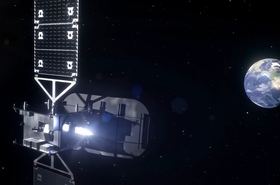
Muon Space has announced an agreement with SpaceX to integrate Starlink 25Gbps mini laser terminals into Muon’s Halo satellite design, enabling optical inter-satellite links within the constellation.
Its mini laser-integrated satellites are planned to launch in the first quarter of 2027.

“High-speed, low-latency connectivity on orbit is foundational for modern space missions,” Michael Nicolls, VP of Starlink engineering at SpaceX, said in a statement. “By integrating Starlink mini lasers, Muon’s spacecraft can remain persistently connected through our in-space laser mesh, enabling real-time tasking, continuous command-and-control, and immediate data delivery to terrestrial points of presence. We’re excited to support Muon Space as [it] brings these capabilities to commercial missions.”
Since 2021, Starlink has been incorporating lasers into its satellite designs and started launching them in 2022, normalizing a technology that has since become industry-standard.
Starlink’s mini lasers can operate at distances up to 4,000km (2,485 miles), though links are easier to maintain at shorter distances. At the speed of light, the barriers to optical are mostly around beam accuracy, and navigating obstacles in the way of the beam, which become myriad in space-to-ground, but are infinitesimal in space.
Another obstacle can be the standardization of these technologies. As developers struggled to innovate differentiation, disruption, and verticalization, a danger of waning satellite interoperability began to emerge, leading to a number of standardization efforts by the US Government, including DARPA’s Space-BACN program. In adopting Starlink’s technology, Muon can tap into SpaceX’s own network, laying the foundations for further collaboration, though perhaps not consolidation, as SpaceX rarely acquires companies.
Santa Clara-based Muon Space was awarded $44.6 million by the US Space Force to demonstrate its dual-use environmental monitoring constellation as part of an SBIR firm fixed price phase III OTA agreement. In August, it unveiled its largest satellite design, the 500kg MuSat XL, at the same time as the model’s first customer, the Seattle-based Hubble Network (unaffiliated with the Hubble Satellite), which seeks to create a satellite-powered Bluetooth network.
Muon currently works with the Earth Fire Alliance, building and fielding its FireSat constellation, a satellite fleet designed to detect and monitor wildfires across the planet, which will now benefit from its leap into optical. Muon estimates that the constellation’s data latency of an average of 20 minutes will reach near real-time speeds, enabling rapid mobilization while fires can still be halted.
"FireSat is already a game-changer for global wildfire response in terms of resolution, precision, and revisit," said Brian Collins, executive director of Earth Fire Alliance, in the same statement. "Starlink's optical connectivity offers the potential to further reduce our data delivery timeline.”





Comments