

As the world marvelled at the incredible 4K video being beamed back from lunar orbit by NASA’s Artemis II Moon mission earlier this year, team members from optical communications startup Azora were sitting anxiously in a California parking lot.
They had driven some 600 miles (966 km) from their base in Phoenix, Arizona, to a location adjacent to NASA’s Optical Communications Laboratory outside Los Angeles, in a bid to prove the capabilities of their portable ground receiver. Designed to enable cost-effective optical communications between space and Earth, the machine had been conceived during a two-week sprint, and had previously only been tested successfully on a link to a geostationary satellite some 22,000 miles (35,406 km) away.

DCD Magazine #61 - Life and death on a tower
The cell tower climbers risking it all to help us stay connected
Would it work over a much greater distance? At 2.50am, the team got their answer. As NASA’s Orion capsule, carrying the astronauts on the Artemis II mission, emerged from behind the Moon, Azora’s system was able to latch on to its signal, proving, the company says, that it can enable an optical communications link at a distance of 240,000 miles (386,243 km).
The success of the Artemis II mission was a boon for free space optics, the idea that light, rather than radio waves, can be employed to transmit information from space back to Earth. This could enable much greater throughput of data to and from satellites, opening the door to a larger space economy, including space data centers.
But several big challenges remain if the technology is to be adopted, not least that optical signals are susceptible to being disrupted by adverse weather conditions. While companies like Azora are trying to address issues of cost and deployability, a new laboratory set up at the University of Suffolk in the UK will provide a testbed to develop more reliable laser beams that could help make optical communication a reality for the space industry.
Free and easy?
Information is traditionally sent back to Earth from space via radio frequency (RF) connections. The technology has served the industry well since the first Apollo missions in the 1960s, and is widely used by defense and communications companies, both terrestrially and in orbit.
But RF is limited in the amount of information that it can handle, meaning the kind of high-definition video delivered by Artemis II (it transmitted live footage from the mission for ten days) would not be feasible via a traditional link.
There are also security issues, too. “RF denial is a big problem,” says Professor Martin Lavery, leader of the Structured Photonics Research Group and professor of optics at the University of Glasgow, and Azora’s CTO. “If you fly anywhere over Ukraine, you can’t connect to the rest of the world because Russia is blocking all radio signals to stop drone attacks.
“It’s likely any future conflicts will involve some form of RF denial, because that in turn hits GPS, and our communication with satellites and other units.”
Enter free space optics. Using light, or more accurately, laser beams, to transmit information is not only much faster, as demonstrated by Artemis II, but also, according to Professor Lavery, completely un-jammable. “The only way to stop it is to stand right in the middle of the beam,” he says. “No one is going to want to do that in a war setting.”
Researchers have been studying the use of optical communication for this purpose for some time, and as a result, several established vendors and startups are bringing ground stations that can transmit and receive optical signals to market.
These include established aerospace technology firms such as Honeywell and Airbus. Honeywell has a Transportable Optical Ground Station, or TOGS, that it says can provide a 1Gbps link to low Earth orbit (LEO) satellites, of the kind used by Elon Musk’s Starlink and other space-based communications vendors. TOGS, which is housed in a shipping container with a retractable telescope that can be unfurled to track satellites, also supports quantum secure communications, meaning data can be transmitted protected by algorithms that can withstand quantum computing-powered decryption. Many experts consider that quantum computers will be powerful enough to decrypt traditional security algorithms in a matter of years, so new, quantum-safe, standards are being developed, and TOGS is built to support the BB84 quantum key distribution standard.
UK startup Archangel Lightworks, meanwhile, has developed an optical ground station that is a lot smaller, with an optical head standing just 1.1m (3.6 ft) tall and 0.7m (2.3ft) in diameter. This, the company says, is designed to be portable, and has successfully connected to a LEO satellite in trials held earlier this year. According to Archangel, the field trials “used the US Space Development Agency laser communication standard and were repeated across multiple passes to prove reliability.”
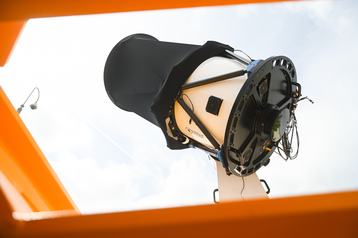
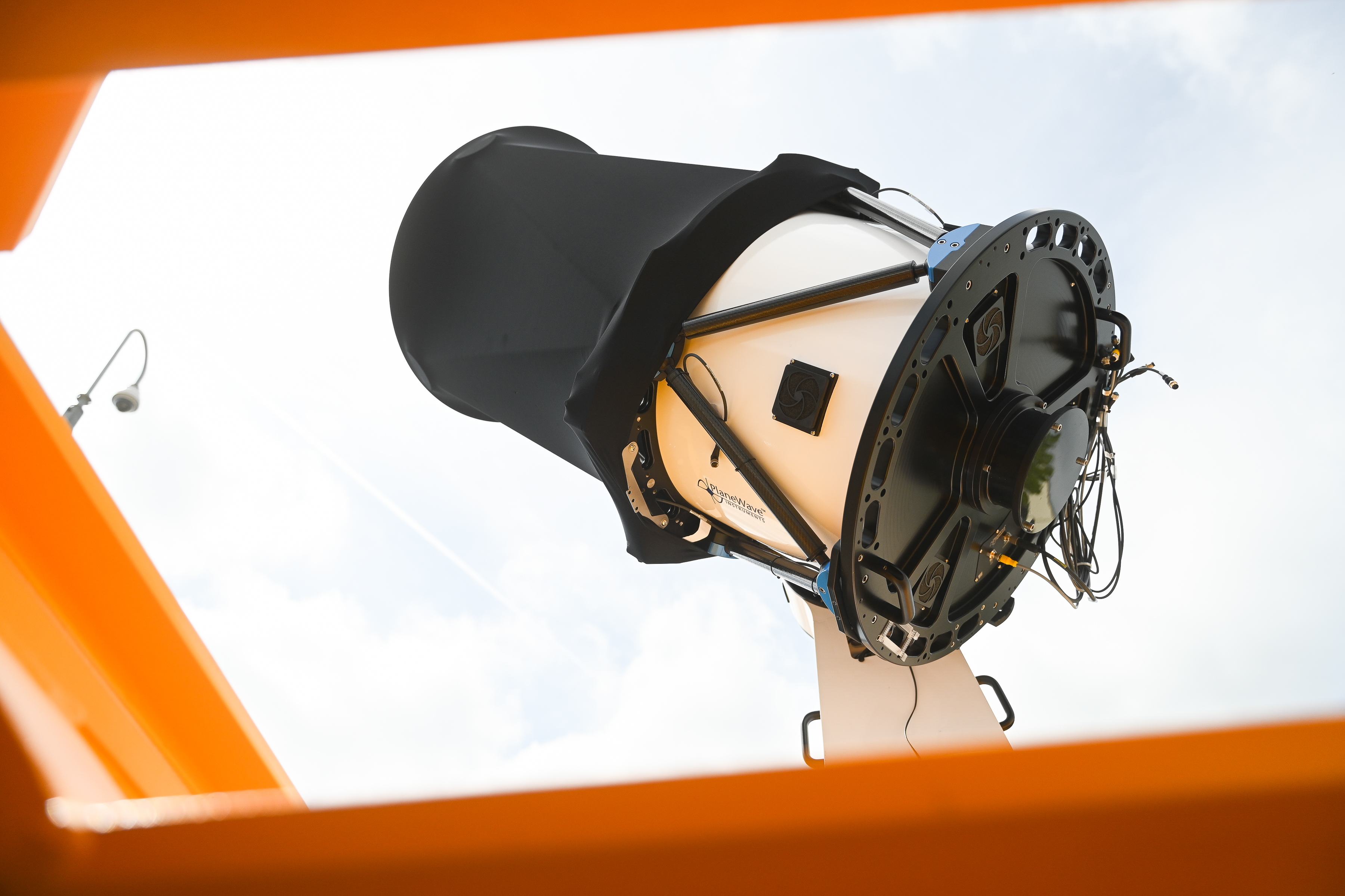
Azora has also designed its system with portability in mind, but, as its recent connection to the Artemis mission shows, is setting its sights higher than low Earth orbit. It has come up with a modular system, with a powerful array of sensors and a telescope with an aperture size of just seven centimeters. This compares to aperture sizes of up to a meter used by NASA to connect with the Artemis II optical signal, Lavery says.
This means a single module is small enough to be carried around in a large rucksack. Several modules can be connected together to make a more powerful system - Azora used two, connected together like a pair of binoculars, to communicate with the Artemis mission. The company claims this portability could be useful in rapidly changing situations, like conflicts, where a satellite link needs to be quickly set up and moved around, but its system could have domestic uses, too.
“The ultimate goal is to turn space communications into something much more like what we’re used to on Earth today,” says James Schalkwyk, Azora’s CEO. “This means having near-constant access to any data and any assets from any location. To do that, you need a network of hundreds of nodes around the world, because LEO satellites move very quickly.
“Space communications has typically been run via a few large, bespoke, expensive systems. We want to move away from that to this technology that can be mass-manufactured, and mass-deployed, at a low price point.”
Azora says its units require just 200W of power, meaning they can be plugged into the mains if located in an urban environment, such as a building rooftop, or run off a battery in a more remote location. The company is currently raising seed funding to help refine its proposition before taking the ground stations to market.
Testing times
Optical communications are already widely used in other settings. DCD has reported extensively on the growing range of photonic products being marketed for data centers, promising to deliver more efficient networking in data halls by allowing information to flow via light, rather than electrical signals.
In space itself, Starlink uses optical networks to send information between its constellation of satellites.
However, these are relatively controlled environments when compared to sending information down through the atmosphere, where laser beams encounter the biggest enemy of optical communication: the weather.
“Wind and fog are the main things that interfere with optical signals,” explains Professor Lavery. “Rain can also affect it, but this will likely just cause some static loss rather than a complete dropout of the connection.” Turbulence caused by wind is a particular problem because it causes small movements in the laser beam, meaning it cannot connect to the receiver on the ground. “For high-speed communications, you’re typically connecting into a small detector or single-mode fiber,” Professor Lavery says. “If your beam is dancing around in the wind, it doesn’t necessarily connect into that receiver.”
Scientists, and companies like Azora, are working on ways to get around this problem, but their efforts have been hampered by the fact that the weather changes like, well, the weather. “If you’re in the UK developing a system, you’re stuck with the weather in the UK,” Professor Lavery says. “You have no idea what’s going to happen if you take it to Saudi Arabia.”
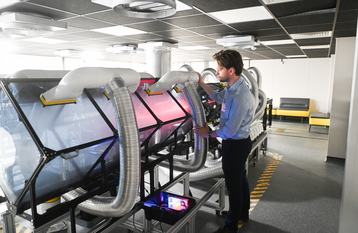
To solve this issue, the University of Suffolk, funded by a £6.2 million ($8.3m) grant from the UK Space Agency (UKSA), has set up a Quantum Optics Discovery (QOD) lab. Based at BT’s Adastral Park research facility, outside the town of Ipswich, it is being used by both Azora (which is also backed by the UKSA) and Honeywell to test their ground stations, and provide a quantum-secure link via satellite between Suffolk and Heriot-Watt University in Glasgow.
Professor Darryl Newport, project lead and director of the Suffolk Sustainability Institute at the University of Suffolk, said: “The QOD Lab represents a significant opportunity for Suffolk and the East of England to play a vital role in the future testing, research and development of optical communications – technology which will play an increasingly important role in the secure transfer of data and information.”
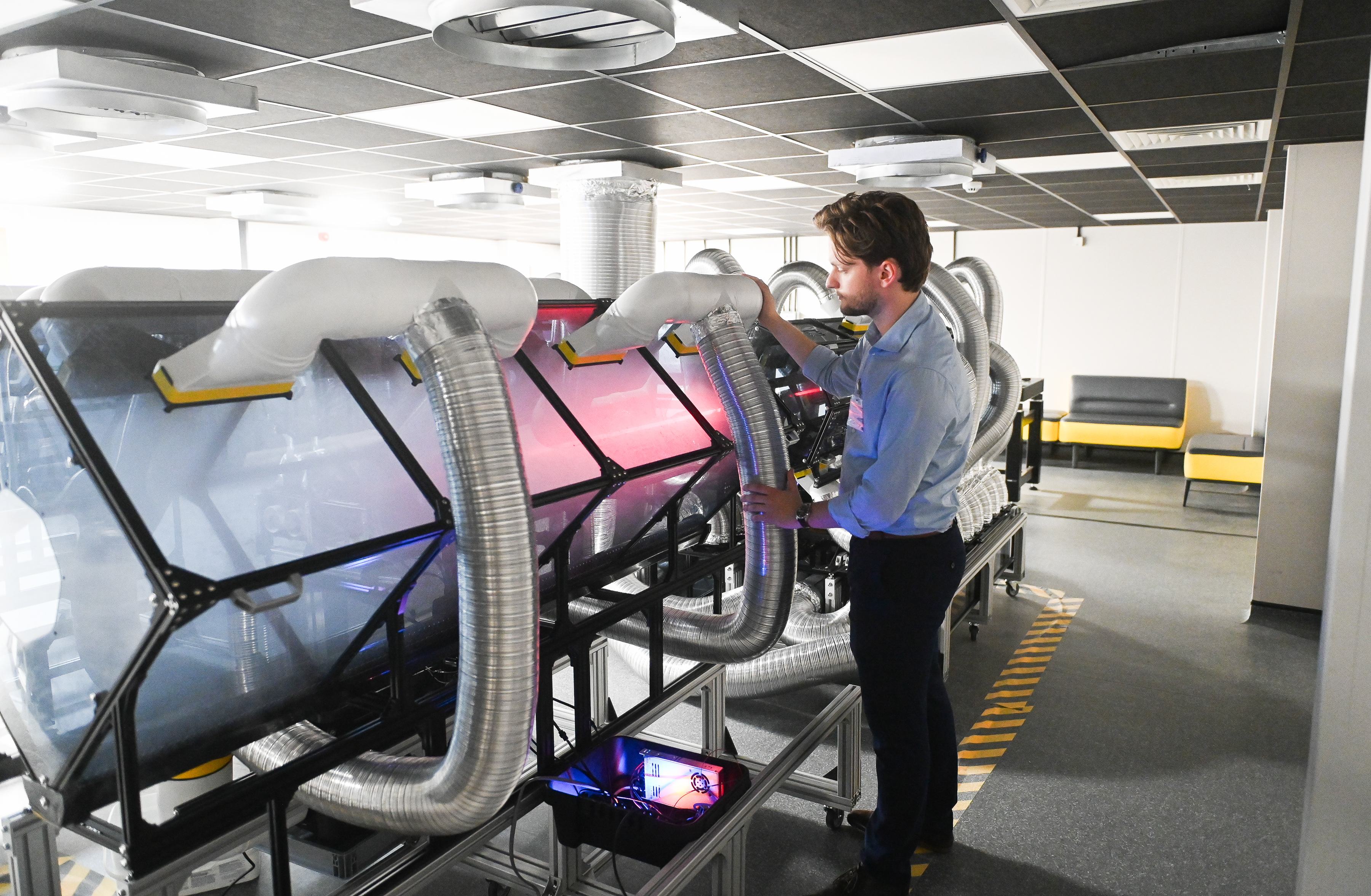
Inside the lab, researchers can access two long tunnels, through which laser beams can be fired. A series of heaters and chillers control air being pushed into the tunnel, so that its impact can be monitored. “We can generate specific turbulence at any of the contact points on the inside,” says Professor Lavery. “That means we can change the configuration to simulate Earth-to-space turbulence, or other conditions, such as when a beam hits hot tarmac.”
The latter will presumably come in handy next time Azora decides to take a trip to NASA’s car park.




Comments