
The Medusa subsea cable is expanding in the Mediterranean and now plans to land in Syria.
“Medusa Submarine Cable System signed an agreement with Syrian Telecom in Tartous (Syria), under the auspices of the Syrian Ministry of Telecommunications and Information Technology, to land the Medusa cable in the country,” the company said this week. “This new landing strengthens connectivity between Europe, the Middle East, and Asia, creating a low-latency, resilient east-to-west route that supports growing digital and AI-driven demand.”
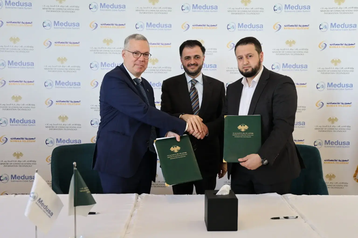
The cable is set to land in Tartus, a port city on Syria’s eastern Mediterranean coast.
First announced in 2022, Medusa is set to run from the Carcavelos area of Lisbon, Portugal, through the Mediterranean to Port Said, Egypt, and Aqaba, Jordan.
The 24-fiber pair system is due to land in Spain, France, the Italian island of Sicily, Greece, and Cyprus. It is also due to land on Africa’s northern coast at multiple points across Morocco, Algeria, Tunisia, and Libya.
Medusa has made its first landing in Marseille, France, and is due to land in Bizerte (Tunisia) and Nador (Morocco) between late October and December. The system is due to go live in early 2026.
AFR-IX has previously signed a deal to land the Medusa cable in Port-Gentil, Gabon, and the company has mentioned a planned landing point in the Democratic Republic of Congo.
The Syrian city of Tartous is currently the landing point for three aging subsea cables. Medusa will be the first cable to land in the country in more than 25 years.
Aletar, deployed in 1997 by a consortium of Liban Telecom, Syrian Telecom, and Telecom Egypt, links the country directly to Alexandria in Egypt. Berytar, also from 1997 and laid by the Lebanese Ministry of Telecommunications and Syrian Telecom, links the Tartous to neighboring Lebanon.
The Ugarit system, dating back to 1995, links Syria to Pentaskhinos in Cyprus. The cable was laid by a consortium of A1 Telekom Austria, AT&T, BT, Cyta, Deutsche Telekom, Lebanese Ministry of Telecommunications, Orange, Singtel, Sparkle, Syrian Telecom, Tata Communications, Telefonica, and Vivacom.
Syria was embroiled in a 14-year civil war that only ended in December 2024 with the fall of Bashar al-Assad's regime. The conflict heavily impacted Syria's energy and telecoms infrastructure.
In 2024, more than 50 percent of Syria's electrical grid was incapacitated due to the destruction of electrical infrastructure and transmission lines, and gas and fuel shortages prevented power plants from operating. Electricity availability was also significantly affected. The country also regularly suffered from Internet connectivity issues during the course of the war.
Saudi Arabian telco Go recently signed an agreement with the new Syrian transitional government to support the country as it rebuilds its digital infrastructure.




Comments