
Google has completed a new water sustainability project in The Dalles, Oregon.
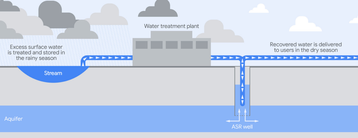
The search and cloud giant announced the completion of a new aquifer storage and recovery (ASR) system in partnership with the City. According to Google, it is part of a deep investment in the state, where it operates several major data centers.
The system works by pumping excess surface water into an existing aquifer for use during drier months. Described by Google as an “underground savings account,” the ASR system aims to support the City in meeting its higher water demand during the summer months, offsetting reliance on local streams. Google also claims that the system will improve local water quality by storing treated surface water for the City and by reducing its reliance on untreated groundwater.
In addition to the ASR system, Google is also permanently transferring groundwater rights associated with the former smelter site to The Dalles. According to Google, this will augment the city’s existing water supplies from local streams and the underlying aquifer, making a previously private resource available for public benefit. As a result of the initiatives, Google claims that it has provided the community with over 100 million additional gallons of water annually.
Google says its decision to support these initiatives is due to the significant water demand its data centers put on the City. Google first entered The Dalles back in 2006 and expanded its facility in 2015. Further tax concessions for two new buildings were granted in 2021. In June 2025, the company announced its intention to make further upgrades to the site.
The company is planning two further facilities at 3500 River Road, with construction beginning in September 2024.
The Dalles ASR project is part of Google’s broader efforts in water conservation. In 2021, the tech giant set a target to replenish 120 percent of the freshwater consumption from its offices and data centers by 2030. In March, the company signed four new partnerships across Chile, California, Taiwan, and France to support water stewardship and sustainable farming practices.
Despite the progress, Google has been criticized recently for a technical paper detailing its methodology for measuring the energy, emissions, and water impact of Gemini AI prompts. According to the paper, the median Gemini Apps text prompt uses 0.26 milliliters (or about five drops) of water. However, some experts criticized the findings, arguing that indirect water use was not accounted for, with the study only accounting for water use in data center cooling, and not the water needed for large generation projects that power the data centers themselves.
In addition to Google, several other hyperscalers have set lofty water stewardship goals. In 2021, Meta announced plans to be water-positive by 2030, and in 2022, Amazon Web Services announced it would be water-positive by 2030, returning more water to communities than it uses in its direct operations.


Comments