

Proper battery storage installation begins with selecting the appropriate technology according to project requirements and risk tolerance.
VRLA (Valve Regulated Lead-Acid) technology offers a well-established and inherently conservative safety profile. A key advantage of Lead-Acid chemistry is its limited intrinsic flammability and predictable failure behavior. Unlike Lithium-Ion chemistry, Lead-Acid batteries do not support the same self-sustaining, self-accelerating exothermic reactions associated with thermal runaway.
Under abnormal conditions such as overcharge, excessive temperature, or internal faults, small quantities of hydrogen may be released through the pressure-relief valve. Appropriate natural or artificial ventilation is therefore required to prevent gas accumulation.
The safety profile of Lead-Acid technology remains one of its strongest and most established advantages. Its mature chemistry, predictable failure modes and decades of use in UPS, telecommunications and other critical stationary applications provide a well-understood safety foundation.
Main fire risk factors
When a cell is severely overcharged, physically damaged or affected by a manufacturing defect, heat generation can exceed the rate at which it can dissipate: this phenomenon is known as Thermal Runaway.
Fire hazards are associated with abnormal conditions, including:
- Improper charging or incorrect voltage settings;
- Short circuits, poor insulation or inadequate connections;
- Damaged or faulty batteries;
- Excessive ambient temperatures;
- Electrical overloading.
Lead-Acid batteries use a different electrochemical chemistry from Lithium-Ion technology and are significantly less prone to severe thermal runaway.
Lithium-Ion batteries operate differently. In this chemistry, this can trigger thermal runaway in which a self-accelerating reaction characterized by rapid temperatures rise and release of flammable and potentially toxic gases from the cell, including hydrogen fluoride (HF).


The challenge is that thermal runaway can propagate from one cell to others, turning an isolated failure into a larger battery event. The reaction can also continue after the initial source of heat has been removed, making these incidents more difficult to control and creating a risk of re-ignition. This is a key difference between Lithium-Ion and Lead-Acid systems, and that becomes particularly relevant when batteries are installed at a larger scale or close to critical infrastructure and occupied areas.
Case study one: a Lead-Acid failure in London
In January 2026, Global Switch’s London Docklands data center experienced a small fire in a battery room, as reported by DCD. The London Fire Brigade responded with eight engines and around 60 firefighters, a deployment reflecting the building’s high-rise status rather than the scale of the incident.
The fire was limited to one of the strings in a room containing around 200 Lead-Acid batteries. It was reportedly extinguished in less than two hours. No one was injured and customer services were not affected. The Fire Brigade described the incident as accidental and linked to the failure of a battery.
Industry commentary later suggested a procedural issue may have been involved, with the isolation switchgear reportedly operated incorrectly during maintenance. The distinction is important: even when a Lead-Acid battery installation does experience a fault, the event is generally contained and manageable with conventional firefighting equipment, as the battery chemistry does not self-feed the fire.
Case study two: a Lithium-Ion failure in New Delhi
A different scenario unfolded in June 2026 at an STT GDC/Tata data center in New Delhi, also covered by DCD. Local fire authorities attributed the fire to Lithium-Ion battery packs. Google Cloud had to shut down network equipment supporting a local point of presence, resulting in several days of increased latency and suboptimal routing for customers.
Tata described the damage as extensive in communications to clients. Customers reported significant disruption to their operations and economic losses. The site also required formal safety clearance before technical teams could return and begin restoration work.
Similar Lithium-related incidents have been reported elsewhere across the Asia-Pacific region, highlighting a broader concern: when a Lithium-Ion thermal event occurs, its impact can sometimes extend well beyond the battery room and create significant operational and recovery challenges.
Neither case suggests that one operator or technology is inherently unsafe and incidents can happen with any battery chemistry. What the two cases show is the different potential scale of the consequences: one fire remained confined to a battery string and was quickly brought under control, while the other required an extended recovery process.
The cost that doesn't show up in the battery quote
This is where total cost of ownership matters. The FV0 classification under UL 94 represents a highly stringent flame-retardancy classification for plastic materials. It requires rapid self-extinguishing behavior and prevents flaming droplets that could propagate a fire. This provides an additional layer of protection against a fire or heat source originating outside the battery itself.
The enclosure is designed to resist ignition and minimize its contribution to flame propagation. This is particularly relevant where multiple batteries are installed in close proximity, such as racks, cabinets and dedicated battery rooms.
When combined with VRLA construction, FV0-rated materials, appropriate ventilation and compliant installation practices, lead-acid technology can provide a particularly reliable approach to fire-risk management. It can also facilitate integration with existing infrastructure and potentially reduce installation complexity.
However, fire-protection requirements must always be assessed according to the specific installation, applicable codes and the authority having jurisdiction. For US installations, relevant standards may include NFPA 855, NFPA 70 (NEC), NFPA 1 and, where applicable, NFPA 13.
Lithium-ion systems, particularly at larger scale, face a more complex and evolving regulatory landscape, including NFPA 855, NFPA 13, UL 9540A and additional fire-safety and insurance requirements from bodies such as VdS and FM Global. Depending on the installation, this can mean additional detection, compartmentation, floor-load reinforcement and insurance requirements. These costs can be significant, but are often missing from early comparisons that focus mainly on the price per kWh.
There is also an important distinction that often gets lost when lithium-ion is discussed as a single category. NMC and NCA chemistries, for example, generally have a lower thermal runaway onset temperature and a higher fire risk than Lithium Iron Phosphate (LFP). LFP has a more stable chemical structure and a higher thermal runaway onset temperature.
That does not make LFP risk-free. Thermal runaway remains possible under severe conditions, and system-level safety still depends heavily on the Battery Management System (BMS), thermal design and overall system engineering. A well-designed LFP installation is not the same risk proposition as a poorly engineered system using the same chemistry.
This distinction matters because the debate around lithium-ion can sometimes become too broad. Treating all lithium chemistries as having the same fire risk is just as misleading as assuming that every Lead-Acid installation presents the same level of risk. The chemistry matters, but so does how the battery is designed, managed and installed.
A decision that should start with the application
Where space or weight are major constraints, or where batteries need to support frequent cycling, LFP can be a perfectly valid choice, provided the system and the battery room are properly designed, with an appropriate BMS, thermal management and trained personnel.
On the other hand, where fire safety, insurance requirements, and regulatory simplicity are the main priorities, particularly in facilities located close to occupied areas, VRLA still offers a significant advantage. The very different outcomes of the London and New Delhi incidents are a useful reminder of how much the consequences of a battery failure can vary.
The right choice depends on the application and the site. What matters is making that decision with the full picture in mind: not just energy density and upfront cost, but also fire risk, infrastructure requirements, insurance, maintenance and the potential impact on operational and business continuity.
More from Fiamm
-
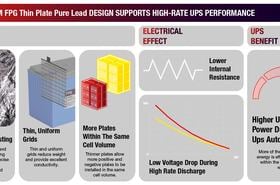
Sponsored What makes a battery a data center battery?
This article explores how pure lead TPPL battery design, low internal resistance and high-rate performance support the specific requirements of modern data center UPS applications
-

Sponsored Optimizing battery systems for data centers
Smart decision-making, good planning and a well-maintained environment will help to avoid potential issues in your setup
-
Sponsored FIAMM Energy Technology introduces the Pure Guard battery range, leveraging Thin Plate Pure Lead (TPPL) technology
The increasing energy demands of data centers, driven by the rapid adoption of AI, are placing new pressures on power infrastructure
Comments