
The Square Kilometre Array (SKA) observatory's data center is nearing completion, including the establishment of two Faraday cages to protect the telescope from radio waves.
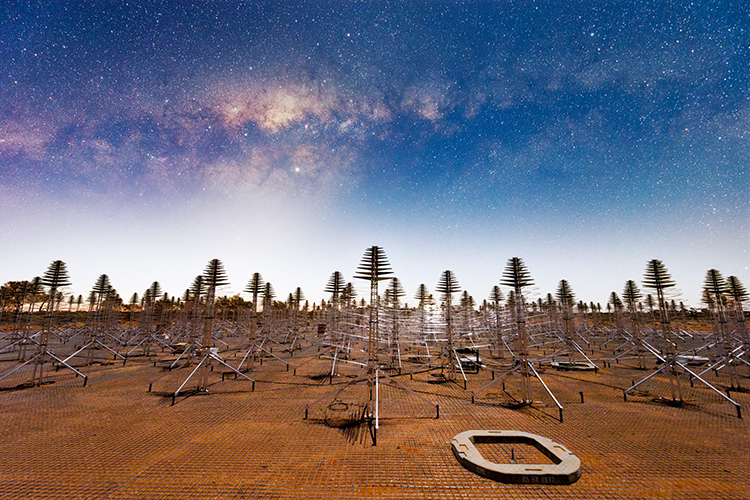
Located in Western Australia, SKA is set to be the world's biggest radio telescope. As per the name, it will span one square kilometer and have 131,072 antennae. Thus far, 12,100 antennae have been installed.
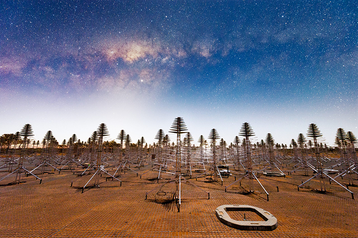
As reported by The Register, the telescope is so sensitive that the data center must have two Faraday cages to protect it from leaked radio waves.
Faraday cages are enclosures built from electrically conductive material to block electromagnetic fields. They are named after Michael Faraday, who first constructed one in 1836.
The data center is located in Murchison and houses around 100 racks. Professor Philip Diamond, director of the SKA Observatory, told The Register that the majority of those racks will be servers with FPGAs programmed to filter the data from SKA, so that only the important information is sent to SKA's supercomputers in Perth.
According to Diamond, as well as being housed within two Faraday cages, the entrances to the building are heavily shielded to prevent any radio waves from escaping. “People effectively go through airlocks,” he said. “The inner door will not open until the outer door is closed. And they make Star-Trek-like noises as they open and close.”
Construction work on the data center is nearly complete, but work on SKA - which began in 2022 - is likely to continue until 2029.
In 2021, the Australian government announced it would spend $64.4m on a supercomputer in Perth for SKA. The project also has another supercomputer in Cape Town. In total, the two systems will have at least 250 petaflops of compute.
DCD has previously done a deep dive on the SKA project. Read it here.





Comments