
Satellite operator SpaceX has developed a novel space situational awareness (SSA) system called Stargaze, which uses 30,000 star trackers across its 9,600 satellite fleet to observe nearby orbiting objects and their velocities.
“While Stargaze embodies a major improvement to the ability of any operator to fly safely, it is imperative for operators to frequently share ephemeris of their own fleets,” the company states on its website.
“This is particularly true for operators with maneuvering vehicles. While Stargaze can detect maneuvers more quickly than any other system in use today, the most definitive source of satellite trajectories should be provided by operators themselves, allowing deconfliction and minimizing collision avoidance maneuvers.”
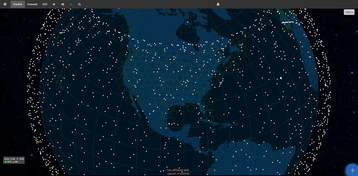
The Stargaze platform will enter a free closed beta, offering its data to “over a dozen participating satellite operators,” which SpaceX has yet to name.
Starting from Spring, other operators willing to submit their own trajectory information (ephemeris), will, in turn, receive live Stargaze data in addition to all information being shared by other participants.
It sounds like a very messy start to something quite worthwhile, assuming this wealth of data can be cross-examined by models capable of understanding the complexity involved.
There’s a reason satellites and space junk are tracked terrestrially via large arrays of sensors plotting information several times a day. Satellites are rarely equipped with the right equipment to observe it effectively, and then usually in one direction at a time. Star Trackers are designed to allow satellites to position themselves by the location of the stars, not tiny moving targets in their vicinity, and certainly not lightless junk.
But satellite situational awareness is a vital technology. SpaceX estimates its 30,000-star trackers are capable of detecting around “30 million transits daily,” which it believes can be used to map the LEO plane through the Starlink constellation and predict collisions.
What SpaceX has that its peers don’t is scale, not so much hardware. There’s a good reason operators use dedicated systems to perform space situational awareness instead of trying to make star trackers do the same thing.
The move arrives not long after Starlink experienced international pressure at a United Nations Security Council in late December, organized by Russia to address “risks and challenges emanating from uncontrolled use of low Earth orbit satellites.” Russia’s case was supported by spokespeople from China and Venezuela.
The meeting occurred after an incident on December 9 in which a SpaceX satellite passed within 200 meters of a satellite launched by a Chinese Kinetica 1 rocket out of Jiuquan Satellite Launch Center. The incident is referenced in loose terms as part of Starlink’s Stargaze announcement, during which it appears to imply China should be sharing more data.
The start of open orbits?
Since the days of the Cold War, international spokespeople have advocated for a more open approach between states for tracking the path of orbiting objects, and the scope of debris present there. Some have called for systems akin to international law governing the use of oceans. Progress on the topic has been slow, with states and companies complaining of their peers’ disinterest in showing their hand first.
Now that SpaceX, the most prominent Western space company by orders of magnitude, appears to be taking steps in that direction, it could compel its peers to do the same in the spirit of cooperation. Certainly, a small Chinese private satellite would have much to gain from joining the program, even if it is a development that seems unlikely.
In any world, an open platform like Stargaze hoping to accomplish its supposed mission will need to collaborate with the BRICS nations. If it doesn’t, the system delivers little more than existing Western tracking databases. It may prove the UN’s prerogative to request that the system serve as a real bridge between power blocs, and not a supe




Comments