
Satellite operator Starlink is changing the orbit of thousands of its satellites this year.
Michael Nicolls, vice president of engineering for Starlink at SpaceX, recently announced a “significant reconfiguration” of the low-Earth orbit (LEO) constellation, bringing its satellites from 550 kilometers down to 480 kilometers over the course of 2026, affecting 4,400 machines.
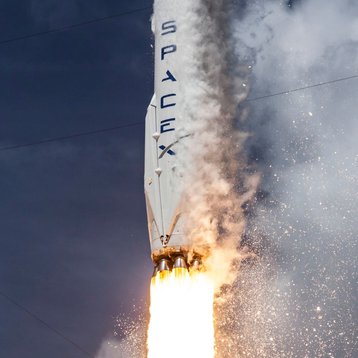
“Lowering the satellites results in condensing Starlink orbits, and will increase space safety in several ways,” Nicolls explained, citing the decreased debris density below 500km, as well as “a >80 percent (sic) reduction in ballistic decay time in solar minimum,” meaning the satellites will fall faster at this altitude.
“Starlink satellites have extremely high reliability,” he continued. “Nevertheless, if a satellite does fail on orbit, we want it to deorbit as quickly as possible. These actions will further improve the safety of the constellation, particularly with difficult-to-control risks such as uncoordinated maneuvers and launches by other satellite operators.”
By lowering its satellites, Starlink boosts its throughput by reducing transmission distance.
The explosive proliferation of small satellites embraced by Starlink has been an industry-defining direction that has compelled many operators to follow suit, even as legacy players continue to run just a handful of high-performance geostationary satellites, and SES continues to explore a smaller medium-Earth orbit constellation.
Nicolls suggested that from this lower altitude, defunct Starlink satellites can be expected to enter destructive re-entry in a matter of months, instead of a maximum of four years.
In recent years, space scientists have begun to raise the alarm about the environmental harm to the upper atmosphere caused by satellite burnup, which pollutes the delicate environment with metal oxides and aluminium particulate that cannot be cleaned. This pollution is understood to cause an even more chaotic set of greenhouse effects on the planet.
“Recent studies indicate that approximately 10 percent of stratospheric aerosol particles already contain aluminium and other metals originating from the ablation of satellites and rocket stages during re-entry,” Dr. Minkwan Kim, associate professor in astronautics at the University of Southampton, told DCD last June. “We do not have the luxury of time for this issue. Immediate action is needed before it is too late.”
International pressure on LEO proliferation?
Starlink’s announcement arrives following an incident on December 9 in which a SpaceX satellite passed within 200 meters of a satellite launched by a Kinetica 1 rocket from the Jiuquan Satellite Launch Center in the Gobi Desert. The launch orbited nine satellites for China, the UAE, Egypt, and Nepal, though SpaceX was not aware which one it almost hit.
Both SpaceX and the Chinese launcher involved, CAS Space, lamented a lack of coordination, despite both failing to communicate with the other throughout the incident, preferring to make prickly public statements about the event on X.
Calls for the normalization of detailed coordination of space activities between nations and power blocs have been grumbled about since the Cold War, with little progress on the issue having manifested since, and progress increasingly reversing as tensions have risen.
In the NewSpace era, Starlink has been infamous for its near misses of space assets, regularly choosing not to warn others or even respond to alerts by the companies and states whose satellites it whizzes by. The International Space Station and Tiangong, two of humanity’s largest space stations, have been forced to perform several maneuvers to ensure they are safe from SpaceX’s massive constellation.
In 2021, the University of Southampton’s Astronautics Research Group estimated that Starlink near-misses occurred 1,600 times per week. Starlink reported that in the first six months of 2025, it performed 145,000 automated avoidance maneuvers – four maneuvers per satellite per month, in a constellation nearing 10,000 satellites.
The latest incident occurred shortly prior to a United Nations Security Council Arria-formula meeting on December 29, organized by Russia to address “risks and challenges emanating from uncontrolled use of low Earth orbit satellites.”
Russia’s case during the two and a half hour meeting was supported by spokespeople from China and Venezuela, who called for more effective regulation of space to avoid heightened risks of debris.
“The delegation of Venezuela considers it necessary for the United Nations to recognize that, under current conditions, megaconstellations represent a tangible threat to the security and sovereignty of non-operating states, violating the spirit of Article 1 of the Outer Space Treaty,” said Marglad Bencomo, the director of telecommunications and space activities for the Venezuelan Ministry of Popular Power for Science and Technology.




Comments