
Space economy infrastructure leasing startup Space Leasing International (SLI) has agreed to purchase two Ka-Band geostationary Earth orbit (GEO) satellites from AscendArc for more than $200 million.
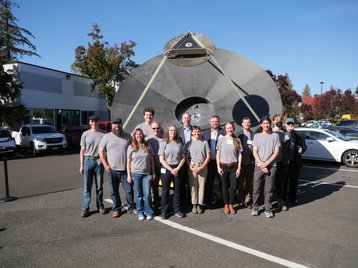
The move is part of a wider partnership allowing AscendArc to offer its satellites on leasing terms instead of requiring an outright purchase. Details on the two satellites weren't shared.
“AscendArc’s approach to design and manufacturing meaningfully improves the economics and throughput performance in GEO, delivering a cost-per-Mbps that stands out and aligns well with what operators are asking for,” Praveen Vetrivel, CEO of SLI, said in a statement. “We expect operators to appreciate both the performance profile and the ability to access this technology through leasing terms that allow them to grow in a capital-efficient way and free up capital for other priorities.”
SLI was established in 2023 by Libra Group, a business group comprising 20 companies in aerospace, renewables, maritime, and real estate. With Libra’s resources, SLI hopes to build a platform to lease orbital resources more dynamically, widening the scope for sourcing customers interested in accessing space technology as opex, not capex.
The leasing group hopes to apply the rules of leasing in the aviation and shipping industry to the architecture of the satellite industry, taking the risk and expense of owning satellites out of the equation for customers, without taking on the risk of having to build and operate them.
AscendArc, which counts Seraphim as an investor, launched out of stealth earlier this year, pitching plans for small geostationary communications satellites.
Chris McLain, founder and CEO of AscendArc, added: “SLI and its parent company, Libra Group, bring a long history of success in high-value asset leasing, along with the credibility and financial strength needed to complete a deal of this scale. Their backing gives our clients a key financing pathway as they plan their missions. We value SLI’s confidence in the AscendArc design and in our team’s ability to deliver – this is an agreement where all parties succeed.”
AscendArc is one of several players looking to deploy smaller satellites in GEO arcs, combining the lower costs and quicker iteration of lower orbit constellations with the greater coverage capabilities of higher orbits. Atsranis and Swissto12 are offering similar capabilities.
The company has previously partnered with KT Sat, the wholly-owned satellite arm subsidiary of Korea Telecom, also known as KT Group.
Space leasing?
Leasing solutions aren’t unheard of in the satellite market, though middlemen who make their business the resale of orbital output are only now emerging.
SLI already owns 13 satellite ground stations as part of a leasing partnership with RBC Signals, a ground-station-as-a-service provider. These include three in Sweden; two in South Africa; two in Chile; two in Singapore; and four in the United States – with two in Alaska and two in Washington State. Many were acquired from Microsoft earlier this year.
The partnership allows SLI and RBC to offer secure communications in every major frequency band in regions with growing connectivity needs. SLI intends to acquire and lease a total of 21 ground stations to RBC Signals.
The downstream economy
Earlier this year, Dr. Maureen Haverty, investment principal at Seraphim Space, spoke to the press about how the capital-intensive, hardware-heavy phase of space investment has built a layer of infrastructure that can deliver more reliable, less risky financial returns. The next wave, she predicts, will be about selling downstream products, primarily data.
“Companies like AscendArc are making satellite connectivity cheaper than fiber,” she explained. “That shift will open up whole new commercial models. … In our early-stage SSV II fund, we’re backing companies like Delos and Adaptive Insurance, which use space-derived data to build new kinds of insurance products.”
This hypothetical data market, where the outputs of satellites become increasingly diverse, numerous, and valuable, will be a complex enough environment to require more dynamic players like lessors, as space becomes a lot more like the seas and skies where Libra Group has made its fortune.






Comments