
Sidus Space has finalized its mission agreement with Lonestar for space data centers.
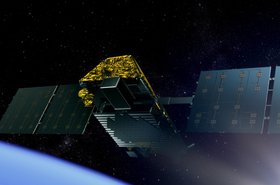
Sidus announced the execution of its Commercial Pathfinder Mission Agreement with Lonestar Data Holdings on the design, development, and integration of the latter’s Edge processing Digital Data Storage Payload into a LizzieSat-5 low-Earth orbit satellite for integration into Sidus’ LizzieSat micro-constellation.

The mission builds on an existing collaboration between the two companies, which previously entered into a $120 million agreement to develop a Lunar data storage spacecraft.
“This mission exemplifies how modular satellite design and integrated partnerships can rapidly advance commercial space innovation,” said Carol Craig, founder and CEO of Sidus Space, in a statement. “By hosting Lonestar’s Data Storage Payload on LizzieSat-5, we’re not only enabling new applications for edge computing in orbit but also strengthening the foundation for secure, scalable data networks across LEO.”
The mission is part of Lonestar’s commercial offering rollout, which intends to enable sovereign, secure, and scalable orbital data infrastructure for long-term storage and processing in space. Sidus will maintain operational control of the satellite through launch and the early orbit phase, establishing a LEO altitude within 500-550km.
Orbital datacenters
News of its new project arrives during a period of newfound interest in orbital data processing. Last month, Jeff Bezos spoke at a fireside chat at Italian Tech Week 2025 in Turin, describing his vision for fleets of gigawatt data centers in orbit, powered by sunlight and cooled by the frigid vacuum of space.
“I bet it’s not more than 20 years,” he said. “These giant training clusters, those will be better built in space, because we have solar power there, 24/7. We will be able to beat the cost of terrestrial data centers in space in the next couple of decades.”
Unfortunately, due to the nature of orbit, satellites don’t have access to solar power 24 hours per day, and face a multitude of other technological issues, not least of them cooling processors in an astral environment unprotected by an atmosphere, meaning the sun can heat them to highs of 220°C.
This, combined with the cyber and ASAT hazards of consolidating important data at a single gigawatt facility instead of distributing it across tens of thousands of satellites, makes data centers of the kind Bezos spoke of impractical for our century.





Comments