
Nvidia unveiled a slew of networking offerings at its GTC event in Washington, DC, including the long-awaited BlueField-4 data processing unit (DPU).
BlueField-4 offloads networking, storage, and security functionality to free up CPUs to run applications and workloads.
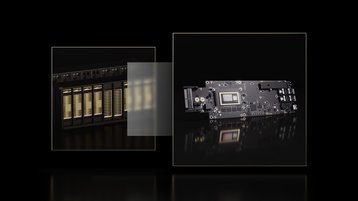
According to Nvidia, its next-generation DPU is capable of supporting a 800Gbps (800G) of throughput to power intense processing workloads.
The chip giant is touting BlueField-4 as yet another component to its wider ‘AI factory’ portfolio, providing software-defined acceleration to enable six times the compute power compared to the prior generation BlueField-3.
“AI factories are the engines of the modern economy – transforming data into intelligence and driving the new industrial revolution,” said Jensen Huang, founder and CEO of Nvidia. “BlueField-4 is purpose-built for the gigascale AI era, fusing data processing, acceleration, and security into the processor for the operating system of AI factories.”
A press briefing ahead of GTC revealed the likes of CoreWeave, Oracle Cloud Infrastructure (OCI), and Palo Alto Networks listed among the partners joining Nvidia’s BlueField ecosystem.
Better late than never?
The BlueField-4 DPU was announced at Nvidia’s GTC 2021 event alongside BlueField-3, and was slated for launch in 2024. However, the chip giant went silent on the hardware, only for BlueField-4 to resurface in DC this week.
BlueField-4 is now expected to launch in 2026 as part of the early availability of the successor series to Nvidia Blackwell, dubbed Vera Rubin.
Addressing the eventual launch of BlueField-4 during a press briefing ahead of GTC, Dion Harris, Nvidia’s senior director for HPC and AI infrastructure solutions, said the company unveils products as early as possible to “prepare the broader ecosystem.”
“These are very complex systems and elements that we're bringing to market, so we're always trying to give as much transparency as we can into our roadmap,” Harris said. “We’re engaged with a lot of the major ISPs, and so a lot of that work is really in getting the ecosystem ready to take this to market. The good news is that as we roll out BlueField-4 with our Vera Rubin platform, it'll be ready, and all the systems will be available to take this to market.”
The expected release window for BlueField-4’s eventual replacement has already been revealed. The aptly named BlueField-5 will, according to Nvidia’s “annual rhythm” or product cadence, be slated for 2028 as part of its Feynman architecture.
ConnectX-9 SuperNIC
In addition to a Grace CPU, BlueField-4 features Nvidia’s new ConnectX-9 SuperNIC, a network accelerator card that Nvidia claims will “push the boundaries of AI networking, scale, and functionality.”
Also coming as part of the Vera Rubin platform launch, the ConnectX-9 NIC provides 1.6Tbps per GPU with built-in remote direct memory access (RDMA) capabilities.
Designed to work as part of Nvidia’s Ethernet-based networking fabric, Spectrum-X, the SuperNIC helps to accelerate data movement. According to the chip giant, the NIC is capable of supporting four times larger clusters compared to BlueField-3, with the company suggesting it’ll be used to support gigascale AI infrastructure.
“We’re unlocking peak efficiencies for AI workloads from training trillion-parameter models to running massive inference jobs,” Harris told the gathered press. “We designed the SuperNIC to be highly extensible. It features enhanced programmable IO (input–output) and comprehensive SDKs to give developers and partners the ability to tailor the infrastructure to the unique AI use cases and future workloads.”




Comments