
Chip giant Intel is seemingly retaining its interest in space data centers.
According to patent analysis platform Patentlyze, Intel has published a continuation application for an orbital data center (ODC) architecture filed December 29, 2025, published last week on August 6, part of a family of patents which propose an unconventional two-tier network in which legions of low Earth orbit (LEO) satellites are coordinated from a handful of more powerful platforms above, which perform edge compute functions serving the LEO network below.
“LEO satellites need to be simple to reduce costs, especially since battery and thruster life is low because of many orbital adjustments caused by Earth's gravitational pull and solar storm damage,” reads an Intel patent filed Feb 17, 2023, and published Feb 3, 2026. “These limited satellite capabilities require routing that is computed by other, more capable compute nodes (eg, on-Earth). Thus, the following approaches include the use of higher-than-LEO orbit satellite constellations—having more processing power—to offload and handle some of the Earth-based processing.”
Intel’s ODC plans are not new, given its patent family spans back to a provisional application filed February 21, 2022. What’s new is that the company is pursuing a continuation application for a roughly four-year-old idea.
“Missing this timeline risks misreading a four-year-old design concept as a new business plan,” said Y. Kobayashi at Xenospectrum.
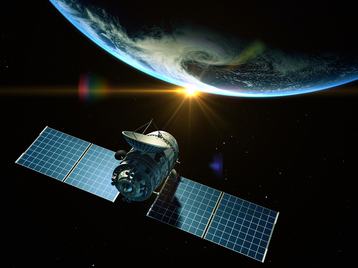
With Intel itself tight-lipped on the subject and its patents still under review – let alone the technologies it describes, the company isn’t exactly planting its flag in the ODC sector.
As yet, none of these patents specify where this command and compute layer would be placed; the February 2026 application lists what the orbits above LEO are, mentioning the radiation-heavy MEO plane, the distant geostationary vantage, and the commercially superfluous high-Earth orbit (HEO), any one of which “may be used to provide network and data processing operations for a LEO constellation.”
The family of patents proposes the automation of satellite fleet management aboard higher-altitude orbital planes – a process which traditionally involves a team of experienced and qualified satellite engineers and space scientists in a specialized control room – on the basis that some of the calculations these experts perform could be done faster aboard orbital data centers. How the orbital data center knows which calculations are relevant to perform is the devil in the details.
Assuming the software is not powerful enough to function fully independent of experts, these distant ODCs will be faced with the delays of receiving and relaying information from the experts in charge back on Earth. Sending a mathematician’s calculator far away from their lab, to be placed as close to the problem they’re trying to solve as possible, has limited guarantees of the subsequent equations being processed any faster.
The February 2026 patent assigned to Intel Corporation lists inventors Stepgen T. Palermo, Valerie J. Parker, and Udayan Mukherjee. The application claims the benefit of priority to patent application 63/312318 filed Feb 21, 2022, and published Feb 17, 2023.






Comments