
Google has launched a new initiative, offering more than $6 million in funding to companies at the cutting edge of the carbon removal and superpollutant sectors.
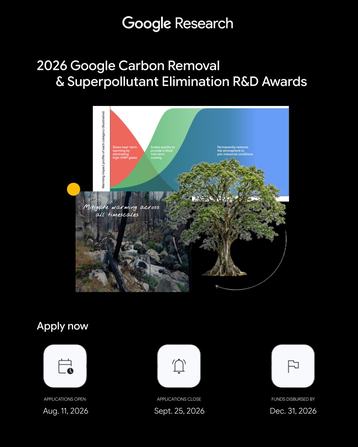
The 2026 Google Carbon Removal and Superpollutant Elimination R&D Awards will target “critical scientific bottlenecks to unlock carbon removal at the gigaton scale and superpollutant abatement at the megaton scale,” said Reilly O’Hara, senior program manager of carbon removal at Google.
The research funding will span several climate and carbon removal technologies, with individual project grants ranging from $350,000 to $500,000.
Ocean alkalinity enhancement receives the most funding, with up to $450,000 available for field trials examining environmental and ecological impacts, and a further $400,000 for assessing how far the approach can scale beyond coastal outfalls.
Carbon capture technology is also well funded. Next-generation capture systems for bioenergy facilities, focused on solid sorbents and metal-organic frameworks, carry up to $400,000 award, while a separate track targeting the energy cost of low-concentration CO2 capture offers up to $450,000.
Biomass and land-based pathways round out most of the remaining funding. Biochar production from difficult, high-moisture waste feedstocks is funded at up to $450,000, mangrove restoration resilience against sea-level rise at up to $350,000, and land-use optimization in nature-based removal projects at up to $400,000. A collaboration with Google Climate & Sustainability on perennial crop systems offers up to $400,000 each for as many as two projects, totaling $800,000.
Methane-focused research includes up to $500,000 for abating diffuse methane emissions through photocatalytic and thermocatalytic systems, with another $500,000 available for refining atmospheric methane lifetime constraints in partnership with Spark Climate Solutions, and up to $450,000 for validating methane models at small-scale landfill sites. A final research area, also with Spark Climate Solutions, funds tidal wetland restoration frameworks at up to $450,000, aimed at balancing carbon sequestration against methane emissions.
Total potential funding across all areas comes to roughly $5.55 million.
The initiative also includes an open call for breakthroughs in carbon removal and superpollutant abatement. The open call will accept proposals that address critical bottlenecks in either carbon dioxide removal or the abatement of superpollutants, including methane, nitrous oxide, ozone-depleting substances, or fluorinated gases. Google will offer funding of up to $450,000 for a single research project.
Individuals at universities, research institutions, non-profit organizations, social enterprises, or businesses focused on advancing research or innovation, can apply for the awards.
Applications are open now through September 25, 2026, with funds expected to be disbursed by the end of the year. Further information on the initiative and how to apply is available here.
The initiative builds on Google's work within the carbon removal sector, where it has become a predominant buyer. Most recently, the company signed a deal with agroforestry carbon removal firm Thryve.Earth to purchase 260,000 tons of carbon removal credits from a reforestation project in Sulawesi, Indonesia. The purchase was made through the Symbiosis Coalition, a carbon-buying consortium formed in 2024 alongside Meta, Microsoft, and Salesforce, which focuses on purchasing nature-based removal credits.
Before this, in March, the company signed a deal with Commonwealth Sortation to purchase 200,000 biochar-related removal credits by 2030.






Comments