
Google's AI research arm DeepMind has announced a research partnership with nuclear fusion firm Commonwealth Fusion Systems (CFS).
The artificial intelligence research (AI) subsidiary of Alphabet will work with CFS to accelerate the timeline for delivering fusion energy to the grid.
Though its technology is still in development, CFS has previously signed a deal to provide fusion energy to DeepMind's parent company, Google, in the future.
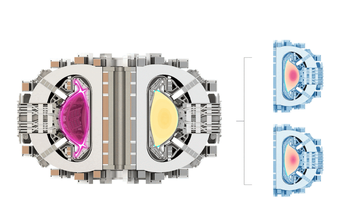
The partners plan to collaborate on three major areas: producing a fast, accurate, differentiable simulation of a fusion plasma; determining the most efficient and robust path to maximizing fusion energy; and utilizing reinforcement learning to discover novel real-time control strategies.
According to the partners, DeepMind will utilize its AI expertise with CFS’s fusion hardware to help advance foundational discoveries in fusion energy.
A central part of the collaboration will focus on the optimization of CFS’s SPARC tokamak reactor - a compact version of a fusion device. The device, which is located at the company’s Massachusetts headquarters, is a precursor to its full-scale ARC project and aims to verify the technology and physics required to build a power plant based on the ARC fusion power plant concept. SPARC is scheduled to commence operations in 2026 and aims to demonstrate net power in Q1 2027.
To optimize the reactor, DeepMind plans to use TORAX, an open-source plasma simulator designed to improve reactor optimization and control. DeepMind claims that the system will help CFS test and refine its operating plans by running millions of virtual experiments before the reactor is made live.
The companies have said that the simulator will give CFS greater flexibility to adapt its plans once the first data is gathered. The software will enable CFS to better understand how plasma will behave under different conditions.
“TORAX is a professional, open-source plasma simulator that saved us countless hours in setting up and running our simulation environments for SPARC,” said Devon Battaglia, senior manager of physics operations at CFS.
The partners also plan to use AI agents to explore vast numbers of potential operating scenarios in simulation to identify the most efficient and robust paths to generating net energy.
In the initial phase of the research project, the partners plan to investigate how reinforcement learning agents can learn to dynamically control plasma to distribute heat from the reactor effectively. The companies claim that in the future, AI could “learn adaptive strategies more complex than anything an engineer would craft, especially when balancing multiple constraints and objectives.”
The research collaboration builds on a Power Purchase Agreement (PPA) signed between Google and CFS earlier this year.
Under the terms of the PPA, Google agreed to offtake 200MW of power from CFS’s inaugural ARC plant. The plant has a planned capacity of 400MW, and is projected to deliver its first power to the Virginia grid in the early 2030s. Google also has the option to offtake additional power from future ARC plants.
The project will be located at the James River Industrial Park in Chesterfield County, Virginia, and is expected to be the first fusion project of its kind to deliver power to an electricity grid, should it launch on schedule.
Following the PPA with Google, CFS signed an additional PPA with Italian energy firm Eni, which the companies said is worth in excess of $1 billion.
The PPA with Eni closely followed the successful close of CFS’s Series B2 funding round, in which it raised $863 million, with Eni increasing its direct investment in the company. Since its founding in 2018, CFS has raised more than $2bn in its quest to commercialize nuclear fusion. The company also counts Microsoft among its backers, with Microsoft providing cloud services to CFS.
Several major hyperscalers have begun investing in fusion energy as a potential future energy source for data centers. Back in 2023, Microsoft became the first data center company to sign a PPA with a fusion firm, inking a 50MW deal with Helion.
However, concerns persist over whether fusion can ever be successfully commercialized, with most projections extending beyond the 2040s.





Comments