
Google-backed nuclear fusion company, Commonwealth Fusion Systems (CFS), has successfully raised $863 million in Series B2 funding, adding a range of international investors to its list of backers.

New investors included NVentures (Nvidia's venture capital arm), Counterpoint Global, Galaxy Interactive, Planet First Partners, and a consortium of 12 Japanese companies led by Mitsui & Co. and Mitsubishi Corporation, among others.
In expanding its global footprint of backers, CFS said that it deepened and broadened its access across the financial ecosystem, with investors that span venture capitalists, private equity firms, sovereign wealth funds, leading individual investors, industrials, hedge funds, pension funds, and banks.
"Investors recognize that CFS is making fusion power a reality. They see that we are executing and delivering on our objectives," said Bob Mumgaard, CEO and co-founder. "This funding recognizes CFS' leadership role in developing a new technology that promises to be a reliable source of clean, almost limitless energy — and will enable investors to have the opportunity to capitalize on the birth of a new global industry."
The oversubscribed round closely follows the signing of a landmark Power Purchase Agreement (PPA) with Google last month. As part of the agreement, Google agreed to offtake 200MW of power from CFS’s inaugural ARC plant.
The plant has a planned capacity of 400MW, and is projected to deliver its first power to the Virginia grid in the early 2030s. Google also has the option to offtake additional power from future ARC plants. The PPA was a continuation of a partnership between the two firms, first signed back in 2021.
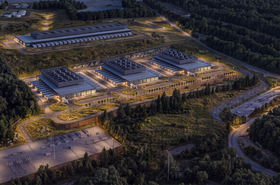
The ARC project is being developed at the James River Industrial Park in Chesterfield County. Should it reach operational status on schedule, it is expected to be the first fusion project of its kind to deliver power to an electricity grid.
Unlike fission, which splits heavy atoms, nuclear fusion generates energy by fusing light nuclei. If commercialized, it could provide a vast, nearly limitless energy source. Yet major hurdles remain, namely, high costs, heat management, and plasma confinement, which have pushed most estimates for commercialization beyond the 2040s.
CFS is currently seeking to prove that it can achieve net fusion through its SPARC tokamak reactor - a compact version of a fusion device. The device, located at the company’s Massachusetts headquarters, is a precursor to the ARC project and aims to verify the technology and physics required to build a power plant based on the ARC fusion power plant concept. SPARC is scheduled to commence operations in 2026 and aims to demonstrate net power in Q1 2027.
The latest funding round builds on the successful raise of more than $1 billion by CFS in May. The company, founded in 2018, has now raised almost $3bn. The company also counts Microsoft as one of its backers, with the company providing cloud services to CFS.
Nuclear fusion is gaining momentum within the data center industry, with more and more hyperscalers looking to invest in the technology. Google has also backed fusion developer TAE Technologies, which recently raised more than $150 million in its latest funding round.
OpenAI has also indicated a willingness to purchase fusion energy to power its data center operations. Last year, it was reported that the company was in talks to purchase "vast quantities" of power from Helion, a fusion power startup backed by OpenAI's CEO, Sam Altman.



Comments