
As demand for digital infrastructure accelerates, data center developers are under growing pressure to move faster without increasing risk. The challenge begins with site selection, where land availability, power access, water, grid capacity, climate exposure, environmental sensitivities, and community expectations must all be understood early. A site that appears viable on paper can become difficult to advance if major constraints emerge after the layout has been established.
That’s why Ramboll has developed Catalyx by Ramboll, our proprietary approach to accelerated project initiation, early site formation, approval, and coordinated design. Instead of evaluating power, grading, access, environmental constraints, permitting, and community considerations in sequence allows clients to consider how these factors interact from the beginning, reducing rework and creating a clearer path toward approval and delivery.
A fully digitalized, bespoke process, Catalyx by Ramboll combines computational design, parametric geometry, GIS, climate intelligence, environmental analytics, optimization and other advanced insights into one shared virtual 3D environment. This allows teams to generate and compare site strategies in days rather than months, understanding how buildings, earthworks, access, utilities, and phasing interact.
Planning power infrastructure from the outset
Power availability is now one of the defining constraints for data center development. Sites may have suitable land, access, and market fundamentals, but still face uncertainty if grid capacity, interconnection timelines, transmission routes, or onsite power infrastructure are not considered early enough.
Catalyx helps address this challenge by bringing power and interconnection planning into the same early-stage environment as site formation, grading, access, environmental review, and development phasing.
This allows Ramboll to test how different power strategies interact with the physical layout of a site, including the space needed for substations, switchyards, generation assets, cable routes, utility corridors, access roads, and future expansion.
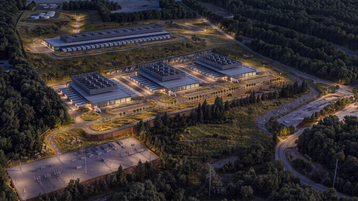
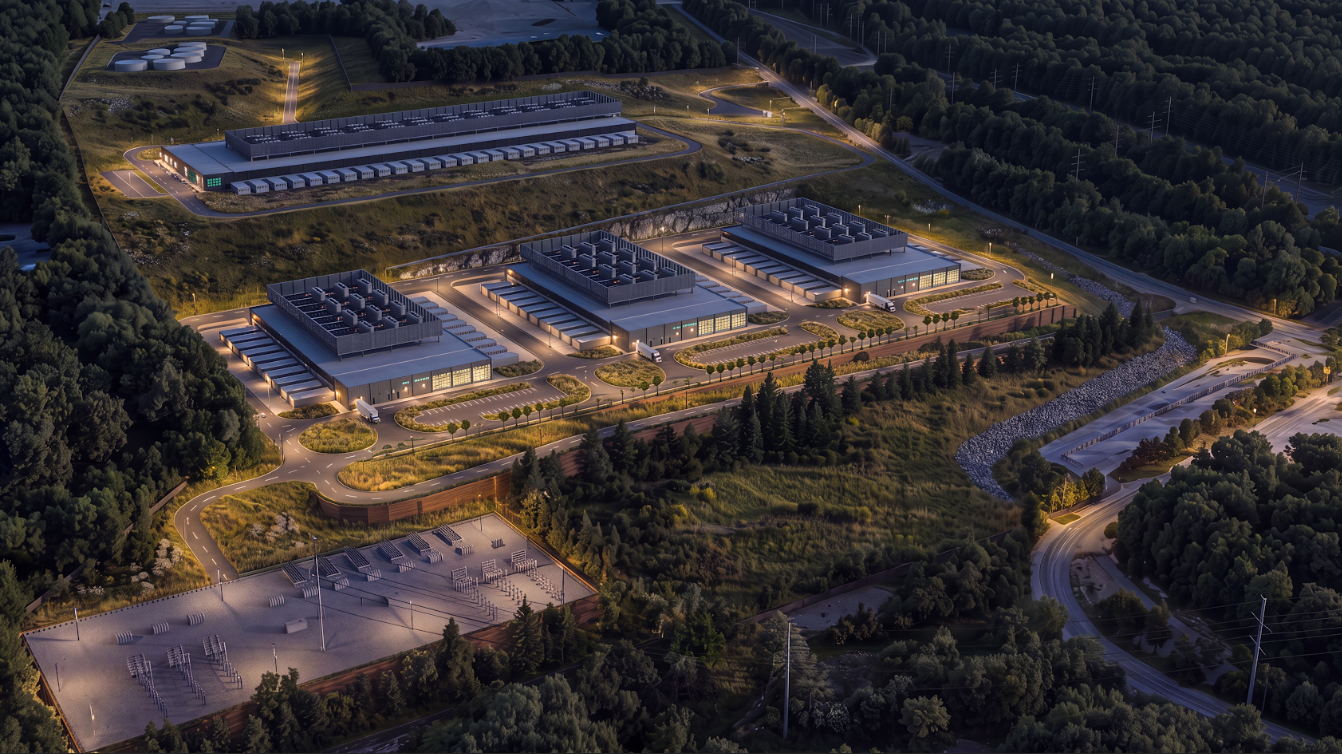
By connecting power planning with master planning, clients can better understand the tradeoffs that influence schedule, cost and deliverability. A layout that optimizes building placement may not be the strongest option if it creates power-routing conflicts, limits future expansion, or increases permitting complexity.
Catalyx allows these issues to surface earlier, helping teams compare options, reduce rework, and create a more coordinated path from site opportunity to delivery.
Embedding climate resilience into site decisions
For data center developers and operators whose business models depend on reliability and uptime, understanding future climate conditions is becoming increasingly important from a business perspective.
One major advantage of the Catalyx approach is its ability to pair with Ramboll’s climate risk assessment tool, HazAtlas, to integrate climate intelligence at the earliest stages of development.
Using HazAtlas, project teams can rapidly evaluate current and future hazards such as flooding, extreme heat, wildfire, sea level rise, severe storms, and water stress. This integration allows Ramboll to ensure that clients understand how climate exposure influences site viability from the outset.
Alternative layouts, elevations, infrastructure configurations, and expansion strategies can be tested quickly against future climate scenarios. Thus, enabling more resilient development decisions while helping organizations protect long-term operational performance and investment value.
Digitizing environmental and biodiversity opportunities
As environmental expectations continue to evolve, developers need better visibility into site conditions before breaking ground. Catalyx incorporates environmental intelligence through Ramboll’s AI-powered environmental monitoring and biodiversity tool.
Using satellite imagery, drones, digital-twin technology, and analytics, Ramboll creates a highly detailed understanding of land conditions, habitat quality, ecological connectivity, and environmental sensitivities that can then be worked into Catalyx’s 3D visualization.
This provides a powerful layer of real-time intelligence during site evaluation and planning, helping teams spot potential constraints before they slow design or permitting. Ramboll can identify environmentally sensitive areas, understand landscape conditions, assess potential biodiversity impacts, and evaluate opportunities for habitat enhancement before a site is selected or any detailed engineering begins.
This shifts environmental considerations from a compliance exercise to a design opportunity, where developers can actively design projects that achieve stronger biodiversity outcomes, improve ecological connectivity, and demonstrate environmental stewardship to regulators and stakeholders.
Helping to earn community acceptance earlier
Catalyx enables Ramboll to evaluate community considerations – such as noise pollution, traffic, aesthetics and more – alongside engineering and environmental criteria. Our experts can then translate those insights into practical guidance for developers. From visual impact assessments and environmental performance metrics to infrastructure demands and sustainability outcomes, we can incorporate community impact data into early-stage planning, allowing project teams to understand stakeholder concerns sooner and develop responses before they become schedule barriers.
The result is a more transparent process that supports meaningful engagement and stronger alignment between developer objectives and community priorities.
A smarter way forward
The future of data center development belongs to organizations that can move faster without creating greater risk. That means moving beyond a fragmented process where engineering, environmental assessments, climate analysis, permitting, and stakeholder engagement happen independently.
It means creating a connected workflow where every discipline contributes to a shared understanding of risk, opportunity, and performance.
Catalyx represents that shift.
“Data centers are critical infrastructure – but how they are developed matters,” Roberts added. “By improving decision-making at the earliest stage through Catalyx, we can help clients deliver infrastructure that is more resilient, efficient, and aligned with long-term societal needs.”
The result is a faster path from site identification to approved project, with reduced risk, strengthened resilience, improved environmental outcomes, accelerated approvals, and, ultimately, infrastructure that is welcomed by communities and designed to perform for decades to come.
For more information, contact Robert Bamford, senior associate at Ramboll.
Comments