
Elon Musk has floated the possibility of Tesla building a “gigantic chip fab” to make artificial intelligence (AI) chips.
Speaking to Tesla shareholders during the company’s annual meeting on November 6, Musk also said the electric vehicle company would “maybe… do something with Intel,” adding “we haven’t signed any deal, but it’s probably worth having discussions with Intel.”
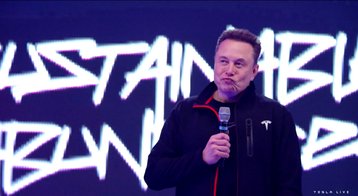
Musk, who claimed to have “chips on the brain,” told shareholders during the meeting that even if Tesla were to extrapolate the best-case scenario for chip production from its suppliers, it still wouldn’t be enough.
"So I think we may have to do a Tesla terafab. It's like giga but way bigger. I can't see any other way to get to the volume of chips that we're looking for. So I think we're probably going to have to build a gigantic chip fab. It's got to be done," he said. According to Musk, this hypothetical fab would produce 100,000 wafers a month for a power-efficient chip optimized for Tesla’s software and with a production cost around ten percent of Nvidia’s Blackwell GPUs.
The comments were made on the same day Tesla shareholders approved a $1 trillion pay package for Musk over the next decade, conditional on the company meeting certain milestones.
Tesla is already working with TSMC and Samsung for the production of its AI5 and AI6 chips at the companies’ respective fabs in Arizona and Taiwan, and South Korea and Texas.
The EV company signed a $16.5bn deal with Samsung in July 2025 for the manufacturing of its forthcoming AI6 chip, to be used in its cars and robots. However, Musk has since clarified that Samsung would also be involved in the production of Tesla’s AI5 chips, previously slated to be solely produced by TSMC.
In a post on social media platform X earlier this week, Musk clarified further that “slightly different versions of the Tesla AI5 chip will be made at TSMC and Samsung simply because they translate designs to physical form differently,” adding that the goal was to make sure Tesla’s AI software worked identically on both.
“We will have samples and maybe a small number of units in 2026, but high volume production is only possible in 2027,” the post continued. “AI6 will use the same fabs, but achieve roughly 2X performance. Aiming for a fast follow to AI5, so hopefully mid 2028 for volume production of AI6. AI7 will need different fabs, as it is more adventurous.“
Intel’s path to profit is paved with partnerships
Shoring up US chip manufacturing has been a key priority for President Donald Trump during his second term in office, and since Lip-Bu Tan took over as CEO of Intel in March 2025, the company has sought to highlight its credentials as a US-headquartered chipmaker with an already established domestic fabrication footprint.
Like TSMC, Intel also has chip fabs in Arizona – the city of Chandler is home to its Ocotillo campus and in early October, the company announced its newest chip fabrication plant on the campus, Fab 52, was fully operational.
Intel said the facility, the fifth high-volume fab constructed by Intel at its Ocotillo campus, will mass-produce the company’s upcoming mobile processors, Intel Core Ultra series 3, and Intel Xeon 6+ data center processors, codenamed Panther Lake and Clearwater Forest, respectively.
In addition to its Arizona campus, Intel also has manufacturing facilities in New Mexico, Ohio, and Oregon, and has been planning to expand its chipmaking presence in Europe and South America.
However, despite being the only leading-edge chipmaker in the US, Intel has continued to see its market share eroded in both the chip design and manufacturing space, leading Tan to announce earlier this year that the company would only move forward with its 14A process node if it secured a “meaningful external customer to drive acceptable returns on our deployed capital” could be found.
Since Tan made those comments, the struggling chipmaker has reportedly reached out to a number of companies regarding potential investments and partnerships, including Apple. Last week, it was separately reported that Intel was engaged in talks with SambaNova regarding a possible acquisition of the AI solutions provider.
These reported discussions follow a slew of large investment deals secured by Intel in recent months, including $2 billion from SoftBank in August and $5bn from Nvidia last week as part of an agreement between the two companies to jointly develop custom data center and personal computing hardware.
In August, the US government also announced it had taken a 9.9 percent stake in Intel, with the state investing $8.9 billion in the chipmaker.





Comments