
Intel has announced that its new chip fabrication plant, Fab 52, in Chandler, Arizona, is fully operational, and that the facility will mass-produce the company’s upcoming mobile processors, Intel Core Ultra series 3, and Intel Xeon 6+ data center processors, codenamed Panther Lake and Clearwater Forest, respectively.
The chipmaker also unveiled new architecture details regarding its Clearwater Forest processors.

Slated to launch in the first half of 2026, Clearwater Forest is set to be the first Intel 18A-based server processor. Developed for hyperscale data centers, cloud providers, and telcos, the processor will contain up to 288 E-cores (Efficient-cores) and offer a 17 percent Instructions Per Cycle (IPC) uplift over prior generation.
Intel claims it will provide considerable gains in density, throughput, and power efficiency, enabling organizations to “scale workloads, reduce energy costs, and power more intelligent services.”
Both Panther Lake and Clearwater Forest will be built using 18A technology, a 2nm class node described by Intel as the “most advanced semiconductor process ever developed and manufactured” in the US. In a statement, the chipmaker said the technology delivers up to 15 percent better performance per watt and 30 percent improved chip density, compared to Intel 35, and that at least three upcoming generations of Intel’s client and server products will be based on the process node.
Intel 18A is one of the final nodes from the company’s '5 Nodes in 4 Years' roadmap and is the first to include the company’s PowerVia power delivery system, RibbonFET gate-all-around transistor architecture, and leverage Intel's open system foundry model.
RibbonFET gate-all-around transistor architecture supports increased transistor density, while PowerVia is a power delivery and signal routing system to enable new device interconnect methods.
“We are entering an exciting new era of computing, made possible by great leaps forward in semiconductor technology that will shape the future for decades to come,” said Intel CEO Lip-Bu Tan. “Our next-gen compute platforms, combined with our leading-edge process technology, manufacturing, and advanced packaging capabilities, are catalysts for innovation across our business as we build a new Intel. The United States has always been home to Intel’s most advanced R&D, product design, and manufacturing – and we are proud to build on this legacy as we expand our domestic operations and bring new innovations to the market.”
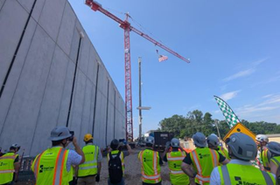
Fab 52 is the fifth high-volume fab constructed by Intel at its Ocotillo campus in Chandler, Arizona. The company also has manufacturing facilities in New Mexico, Ohio, and Oregon, and had been planning to expand its chipmaking presence in Europe and South America.
However, following a turbulent time for the company, which has seen its market share eroded both in chip design and manufacturing, and its former CEO Pat Gelsinger replaced, Intel pulled the plug on its planned chip fabs in Germany and Poland, and ended its assembly and test operations in Costa Rica.
The chipmaker has also overseen multiple rounds of mass layoffs, and in July, Intel said that it may be forced to cancel or pause the development of Intel 14A and successor leading-edge nodes due to financial difficulties.






Comments