
The US government plans to fund research into revolutionary separation technologies for ore processing to achieve "domestic resource independence."
The Defense Advanced Research Project Agency (DARPA) has kicked off the 'Smash' program, which aims to achieve efficient, near-zero-waste separations across the periodic table while remaining scalable to industrial mining operations.
If achieved, the four-year program would give the nation control over its supply chain, allow it to access critical rare earth elements key to the development of semiconductors, and increase its production of copper and other metals.
The program comes as China increasingly looks to use its near-monopoly on rare earth processing to control global supply chains, restricting the export of dysprosium, gallium, germanium, and other key materials during trade disputes with the US.
Supply chain smash
Despite their name, rare earth elements (REE) are not rare. They are scattered across the globe, but are unlikely to be found in easily harvestable deposits. Instead, the dispersed material has to be processed - an expensive and difficult task.
While REE can be found in numerous nations, China has taken the lead both in mining and, more critically, in processing.
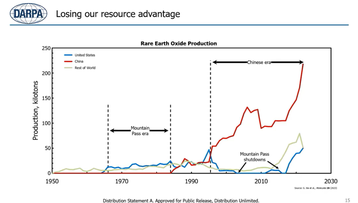
“In the case of rare earths, the United States was the dominant global manufacturer from the ‘60s to the ‘80s,” Smash lead and DARPA program manager at the Microsystems Technology Office (MTO), Julian McMorrow, said in a project presentation.
“At some point, we decided we didn't want to compete anymore, and China stepped in to fill the vacuum, and they haven't given it back. When we tried to start back up, maybe about a decade ago, they were so dominant in the market that we couldn't compete on price. We had to shut down the mine*. And we find ourselves playing catch-up today.”
This represents a major economic and military weak point for the US. “Our trade partners have demonstrated the willingness to use gallium and germanium as weapons against us and to attack our manufacturing of microelectronics,” McMorrow said.
Smash is not purely focused on REEs, however, and aims to better process and separate all 80 stable elements. “Looking forward, the pain points are predictable. When it comes to copper, water scarcity and diminishing ore returns tell us that about 60 percent of our microelectronics manufacturing is at risk in the coming decades.”
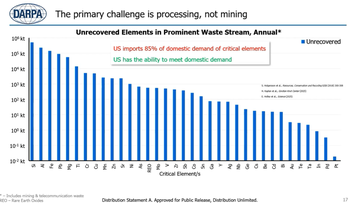
The materials that the nation needs already exist in the ore that mining companies are extracting, McMorrow said. Smash will redefine how and where the United States sources its raw materials. “As mining waste or as commercial waste, we throw away kilotons to megatons of all these elements identified in the DoW [DoD] critical minerals list. If we compare what we throw away annually to our own manufacturing demand, we find that our supply exceeds our demand, and in many cases by many orders of magnitude.”
The problem is that, for over a century, the industry has processed individual elements - often in expensive, water-intensive, and toxic processes that render the remaining material a sludge that is disposed of. For example, more than two tons of ore (plus 13 tons of water) lead to just one kilogram of copper - everything else is waste.
“So the challenge is processing, not mining,” McMorrow explained. “We want to develop technologies to take the industry from wasting over 99 percent of its feedstock to making use of the entire feedstock and producing high-purity material from each of its constituent elements, giving us the asymmetric advantage in yield purity and energy utilization to be dominant in the raw material space again.”
Mass spectrometers are already able to sort molecules by mass and charge, but is prohibitively expensive and incredibly slow. However, McMorrow notes that we can also look to the petroleum industry for how it efficiently separates different oils and fuels.
In a non-exhaustive list, McMorrow detailed some technologies that could be used for Smash - from microbial fluids, to plasma thrusters, to Faraday cups. Smash will cover preparing feedstock, separating the elements, collecting the elements, and recovering energy.
Longer-term outcomes of Smash could include using such processing systems “in the case of what the military calls expeditionary manufacturing,” McMorrow said, with the technology used to “generate electronic-grade material for forward-deployed service members.” Similarly, it could be used on the Lunar surface, which is rich in silicon, aluminum, oxygen, and other elements. “Asteroid mining [is] kind of the same story,” he said.
Smash is a 48-month, two-phase program. Phase 1 (24 months) focuses on proof-of-concept experiments and modeling, while Phase 2 (also 24 months) drives prototype development.
Program proposals are due 24 April, with Smash expected to begin 1 September.
Whitney Mason, director of Microsystems Technology Office, said: “The ability to extract every material from your shovel of dirt at high purity is going to change the way we can build products. It's also going to change the way we innovate. This is going to allow us to stop relying on other countries to process our ore.
"It's going to allow us to take advantage of every single element in the shovel of dirt by creating byproducts that render these elements unrecoverable. And it's going to allow us to stop shipping our e-waste back to these countries so that they can take advantage of our materials.”
*On US rare earth mines
The mine referenced by McMorrow is Mountain Pass, the largest single known deposit of rare-earth minerals such as cerium, lanthanum, neodymium, and europium. Originally a gold mine, it produced 70 percent of the world’s rare earth supplies by the early 1980s.
Less than two decades later, it switched from selling refined REEs to just bastnäsite (cerium, lanthanum, and yttrium) concentrate due to the costs of refining.
A 2002 toxic waste spill caused what was meant to be a temporary closure - but with China's state-supported REE industry bringing commodity prices down, it was decided to keep it shut.
Multiple attempts were made to reopen the mine. Molycorp acquired the site in 2008, raised $400m, built a new ore processing plant, and restarted production in 2012. Despite the plant reaching full production, Molycorp entered bankruptcy in 2015.
In 2020, a new company emerged, looking to once again revive the only operating rare earth mine and processing facility in the US, this time looking to use national security concerns as a way to beat market forces.
MP Materials currently primarily focuses production on Neodymium-Praseodymium (NdPr), high-strength permanent magnets necessary for electric vehicles, wind turbines, drones, robots, aerospace, and defense systems. It also produces cerium, lanthanum, and other separated and refined products.
The company has turned to the US government for support: Gaining a Department of Defense (DoD) contract in 2020, $3m from the DOE in 2021, and a $35m investment from the DoD in 2022 under President Joe Biden. In 2025, under President Donald Trump, the DoD became the company's biggest investor with a $400 million infusion - alongside a promise to buy its output for 10 years at double the current market price.
Last July, Apple announced plans to spend $500m on rare earth magnets from MP Materials, as part of a broader push to increase its US supply chain.
DARPA Smash, however, notes that relying on a single, centralized mine represents a risk. “It leaves our companies and our economy at risk of disruption from economically or otherwise,” McMorrow said, with the program looking to achieve universal processing of different elements from a diverse feedstock.







Comments