
Direct-to-device satellite company AST SpaceMobile has lost its BlueBird 7 spacecraft following a failure in the positioning stage of its Blue Origin launch, aboard the New Glenn rocket.
After the launch on April 19, Blue Origin noted that SpaceMobile had confirmed the satellite had powered on, but the payload had been placed into an "off-nominal orbit."

“Now that we have a more complete view, we wanted to provide an update on our NG-3 mission,” said Dave Limp, CEO of Blue Origin, in a post on X.com, reposted by the company the following day.
“While we are pleased with the nominal booster recovery, we clearly didn't deliver the mission our customer wanted, and our team expects. Early data suggest that on our second GS2 burn (the second stage), one of the BE-3U engines didn’t produce sufficient thrust to reach our target orbit. Blue Origin is leading the anomaly investigation with FAA oversight to learn from the data and implement the improvements needed to quickly return to flight operations. We have been in steady communication with the team at AST SpaceMobile, we appreciate their partnership, and we’re looking forward to many flights together.”
Blue Origin did not speak to claims that the Federal Aviation Authority (FAA) would be grounding the rocket pending an inquiry.
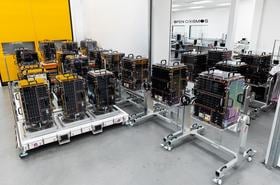
BlueBird 7 is part of AST’s newer generation of satellites, featuring 2,400 square feet (223 sqm) of arrays, a feat that makes them “the largest commercial phased arrays ever deployed in low-Earth orbit,” according to the company. The satellite is insured for $30 million (€25.5m) with a carrier not disclosed by the company’s SEC filing.
Texas-based AST SpaceMobile suffered a 15 percent slump in share price on the day of the event, losing $12.54 down to $72.99, and another five percent on April 20, undoing the 18 percent price growth the company had enjoyed in early 2026.
Stock observers suggested the company lost roughly $2 billion in market cap from the high-profile incident, despite strong performance, with a market cap up 517.95 percent from the year before. The company's share price has partially recovered, trading at around $83 at time of publication.
What happened?
The launch began like clockwork, despite the use of a first-stage booster variant that hadn’t been used before.
The booster, ironically nicknamed “Never Tell Me the Odds”, successfully set down on the landing-platform barge “Jacklyn”, named for Jeff Bezos mother, in the Atlantic Ocean after performing its role, a complex feat in its own right.
It was the upper stage where things took a turn, with an engine failing to fire correctly, bringing BlueBird 7 to a non-nominal, highly elliptical orbit too low to operate, at 154 x 494 kms, with insufficient fuel to reposition higher using onboard thrust.
AST SpaceMobile has confirmed the satellite “will be deorbited deliberately in a controlled manner”.
Post-launch investigations are suspected to take months to conduct, with a review due to the FAA. It’s not the news Blue Origin needs, with test flights for Artemis III on the horizon in 2027, serving a set of billion-dollar contracts.
The fallout
Some observers are turning a critical eye on the roughly 6,100kg LEO (low-Earth orbit) satellite’s design, given that many LEO models weigh in below the half-ton mark, making them easier to orbit in higher numbers.
While BlueBird 6 was orbited without complications with the Indian Space Research Organisation (ISRO)’s LVM3 rocket last December, some are starting to question whether having the biggest, heaviest satellite exposed to the high-end of microgravity in the low-Earth plane is a productive trade-off. The New Glenn is capable of bringing nearly 50 tons to low-Earth orbit.
Unconfirmed reports, speculated by outlets like Advanced Television, suggest AST will be forced to modify its satellite designs to add stronger onboard thruster capability.
“The company is currently in production through BlueBird 32, with BlueBird 8-10 expected to ship in approximately 30 days,” AST SpaceMobile said in a statement, “[we expect] an orbital launch every one or two months on average during 2026."






Comments