
Our climate reality is deeply varied, nuanced, and constantly changing. Yet, many infrastructure decisions are expected to deliver results for decades to come.
So ask yourself: Could I confidently make a million-dollar infrastructure decision based on what I know about my data center today? Would that decision still make sense tomorrow?
As operators race to support the latest generation of high-density chips, attention is increasingly focused on technology cooling systems capable of delivering temperatures as high as 45°C/113°F . The logic appears straightforward – the warmer a facility can operate, the easier it becomes to reject heat using ambient conditions rather than energy-intensive mechanical cooling. Since the compressor is typically the largest power consumer in a chiller, the assumption quickly follows that compressor-less cooling is the obvious path to greater efficiency.
In many cases, greater reliance on free cooling or economization via outdoor air, dry coolers, or adiabatic systems can indeed reduce facility energy consumption. But the reality is more complex.
Chip specifications are only part of the equation. Location – and everything that comes with it, from geography and climate to ambient conditions, water availability, and thermal differentials – can be just as influential in determining the most effective cooling strategy.
According to Maurizio Frizziero, vice president for chilled water systems at Vertiv, where a data center is built may be just as important as the technology it is designed to support.
The name of the game: Efficient thermal management
The past two decades have seen a notable evolution in data center density, server technology, and cooling requirements. Heat rejection demands and operating temperatures have increased at a lukewarm pace, but since the 2022 generative AI boom hit, things have really been heating up. The arrival of increasingly powerful AI GPUs and CPUs has dramatically accelerated thermal challenges.
“The entire thermal chain needs a redesign as a system,” says Frizziero, adding:
“Traditionally, almost every data center relied on air cooling, with chillers and CRAH units operating in a narrow band – water at roughly 17-25°C (63-77°F) and air up to about 27°C (81°F). With AI and high‑density GPUs, we’re now talking about water temperatures closer to (104°F), and that completely changes the rules for thermal design.”
This rapid transformation has sent shockwaves through the industry, with operators catching metaphorical heatstroke trying to navigate the right direction for their cooling strategies.
As a provider across the full thermal chain, Vertiv sees a responsibility to help navigate this period of rapid change. That commitment was the driving force behind the development of a new framework designed to help operators chart a path toward efficient thermal management.
While chip temperature is an important consideration, it is neither the beginning nor the end of the equation. Rather, it is one piece of a larger puzzle that also includes critical factors such as local climate conditions and water availability.
“We developed the white paper (Rising chip temperatures and the transformation of data center cooling) to help educate the industry and explain the challenges involved. The reality is that the more we, as a community, can adapt, optimize, and build future-ready systems, the more efficiently we can use energy, water, and space. That is our responsibility as operators,” explains Frizziero.
“We approach this with the understanding that every kilowatt of power and every gallon of water saved can have a meaningful impact on the world around us.”
Mapping data center cooling to climate reality
Standard chillers, high‑temperature chillers, dry coolers, and chiller-free cooling hybrids are all valid parts of the thermal chain. The right solution for any operator depends on a range of factors, including:
- Climate (hot vs cool environments)
- Ambient conditions vs local microclimates (Frizziero uses the example of rooftops packed with hot, noisy units, where temperatures can far exceed the reported outdoor ambient)
- Noise constraints (sound barriers can reduce noise but also trap heat)
- Water availability (which influences how much evaporative or adiabatic cooling can be justified).
“It depends on the location. If you are in a very cold climate and need to produce high water temperatures, you might not need a compressor. If you are in a very hot ambient condition, you need compressors to cool water to below the outdoor air temperature – that’s just thermodynamics,” states Frizziero.
Of course, the reality extends beyond these factors alone. As technology evolves and climate patterns become increasingly unpredictable, designers are effectively working with a moving target. Today’s cooling decisions must not only account for current operating conditions, but also the demands of future IT generations. As Frizziero explains:

“A server can be replaced every two or three years, probably even faster in future. A data center, once it’s designed, will be in place for at least ten years – and it takes a couple of years just to design, procure, and implement. So any design has to work across multiple generations of IT.”
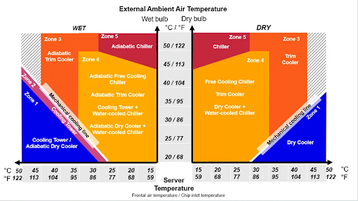
To help operators navigate these complexities, Vertiv’s engineering experts developed a chilled water heat rejection map, designed to identify the most effective cooling strategy for a given set of conditions.
The map divides deployments into five distinct zones, each defined by the intersection of server temperatures and external ambient conditions. The result is a framework that guides operators toward the most appropriate solution, be that water-enabled compressor-less cooling, hybrid cooling, full mechanical cooling, or a mixed mechanical approach.
But the framework goes beyond matching cooling technologies to today’s conditions. Beyond cooling technology and environmental conditions, flexibility emerges as a critical third axis. This axis draws flexibility over time – measuring how readily a cooling system can adapt as server architectures, power densities, and cooling requirements evolve over time.
Some operators may choose to optimize aggressively for current conditions, while others may prioritize greater long-term adaptability. Neither approach is inherently wrong, provided the trade‑offs are understood and aligned with business objectives.
“That’s why it’s important for us to provide the full thermal chain and to have a wide variety of products – dry coolers, trim coolers, high‑temperature chillers, free cooling, centrifugal chillers. They’re like different cards people can play in their own strategy.”
With Vertiv providing that deck of cards, and the white paper serving as a guide to the rules of the game – grounded in fundamentals such as thermodynamics that do not change – the framework helps operators identify configurations that balance present-day optimization with future flexibility.

The Cooling Supplement
Achieving efficient data center cooling
A key to success
What this discussion ultimately reveals is that there is clear risk in reducing data center cooling strategy to a universal compressor-less narrative. The feasibility of elevated chip inlet temperatures is not guaranteed in every environment, and ultimately, it is the reality of local conditions that determines what is possible.
Once environmental factors enter the equation, thermal management ceases to be a single-player game. Operators, consultants, designers, contractors, technology vendors, and end users all have a role to play in creating efficient, resilient cooling strategies. Success depends on collaboration and understanding across the entire ecosystem.
These are multi-million dollar decisions, and they demand a multi-player approach.
Download the white paper ‘Rising chip temperatures and the transformation of data center cooling’ here.
More from Vertiv
-

Adaptive cooling solutions for hybrid data centers
Future-proof AI-ready data centers with hybrid cooling solutions that adapt to evolving workloads while protecting infrastructure investments
-

Sponsored Rethinking the thermal chain
As rack densities increase and liquid cooling becomes more widespread, operators must adopt a more integrated and flexible approach to thermal management
-

Vertiv's acquisition of ThermoKey closes
Expands cooling tech with Italian deal
Comments