
It’s impossible to avoid AI right now. It's everywhere, whether on social media, in the workplace, or being used to plan out your dream kitchen; it's inescapable.
So it wasn’t a great surprise that the main talking points at this year’s Mobile World Congress centered on AI.
In many ways, it was a continuation of last year’s event, which was also dominated by AI. That said, it did feel as if some substantial progress around AI had been made in the last 12 months.
This year marked the event's 20th anniversary in Barcelona, Spain, and despite travel chaos from the war in the Middle East, more than 105,000 people attended, according to organizers GSMA. DCD was on hand to summarize some of the main talking points.
Tucking into AI
While most people expect to feast upon tapas when visiting Barcelona, MWC had something different on the menu, which, of course, was AI. Those letters were slapped across every stand across the eight halls of the Fira.
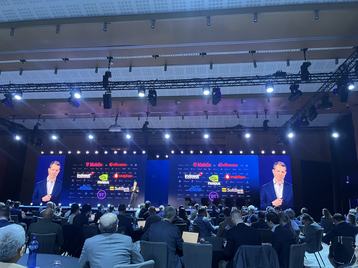
Before MWC had even officially started, Nokia unveiled its AI-RAN (radio access network) strategy at the vendor’s Day Zero press and analyst event.
“AI is the new workload reshaping networks. That shift requires architectural change across every layer – including the radio,” says Justin Hotard, CEO, Nokia.
Hotard claimed that AI already generates traffic with 1.3 trillion annual sessions, made up of what he calls "discrete AI engagements" totaling more than 100 trillion tokens a day. On stage, he was joined by a host of mobile carriers and tech giants, including T-Mobile US, Indosat, as well as SoftBank and Nvidia.
Much of this was to highlight the importance of AI RAN, something that will be essential for the 6G era, or so the vendors are saying.
"Physical AI requires an intelligent network underpinned by AI‑RAN so operators can fully harness distributed intelligence across every layer of the network," states Ronnie Vasishta, senior vice president of telecommunications, Nvidia.
Some of the physical AI use cases include autonomous robots/drones, self-driving cars, smart manufacturing/cobots, and predictive maintenance. Examples of these were scattered across MWC, most notably in the form of robots and drones.
Nvidia’s telecoms focus
Sticking with Nvidia, the company was somehow everywhere and yet nowhere at the same time last week.
Telco vendors, mobile operators, hyperscalers, and more all unveiled announcements with Nvidia, with the AI future in mind, with many exhibitor stands making reference to their partnerships with the company.
All of this, even though Nvidia didn’t have its own stand across the eight halls. But in truth, the tech giant, which is arguably best known for its GPUs, didn’t need one. And, although Nvidia has been working with telecoms companies for several years, this year it felt that the company’s ties to the telecoms industry have never been greater.
"Our goal in the telecom industry now is to build highly optimized base stations, 5G base stations, and 6G going forward that will be AI-native, fully software defined," says Soma Velayutham, general manager for AI and telecoms, Nvidia.
Velayutham adds that this is the “iPhone moment” for the base station. The iPhone has, of course, been very successful, and Nvidia and telcos from across the world are banking on AI RAN to help claw back some return on this investment.
He tells DCD: "The base station is going to enable the ability to generate apps. On top of that, the signs are already there. There's something called rApps, xApps, dApps. These are coming on because now you make this software defined and programmable, which is very important for us to generate value for this industry."
He suggests it could be an opportunity to freshen up the standards that support the future RAN networks.
"If you look at the algorithms that RAN has been written on in wireless cellular technology, it's actually 50 years old," adds Velayutham. He explains that utilizing AI within this RAN will support workloads and help to improve the spectral efficiency.
AI roads lead to 6G?
While it felt a bit too soon for 6G chatter last year, this year’s edition of MWC was a different story, and this was largely due to the conversations around AI.
Although telecom operators were reluctant to talk too much about 6G, that didn’t stop some of the industry’s other big-hitters, notably vendors such as Nokia and Ericsson, and chip giant Nvidia.
Mark Giles, lead industry analyst at Ookla, explains to DCD that it was “inevitable” that 6G would become more of a talking point this year, noting that geopolitics has made the 6G race more interesting.
“Whereas before it seemed like, for the 5G era, it was the telcos really marketing the need for 5G there to drive innovation and revenue, it now seems like it's more of a geopolitical push,” says Giles. “Governments have been driving a lot of the impetus behind the latter development of 5G and even into the 6G era.”
Although the 3GPP standards around 6G are still to be defined, Giles is unsure as to whether 6G will be able to deliver a “big bang” type change that 4G offered instead of 3G, while saying it’s likely the “AI era” instead of 6G.
In a timely announcement ahead of the show, Ericsson carried out a 6G pre-standard over-the-air (OTA) session.
The test was done at Ericsson's US HQ in Plano, Texas. Ericsson's demonstration featured radio hardware, RAN Compute, software-defined air interfaces, and cloud platforms.
Howard Lutnick, US Secretary of Commerce, hailed the test, further highlighting the US government’s priority of future technologies.
Expect other vendors to follow suit, as the race to hype up 6G heats up.
Repeating the same mistake again?
However, not everyone is convinced that 6G will be the solution for the telcos’ problems.
Most of the 6G talk may have come from the vendors, but some view this as a repeat of the 5G era, where hype has not matched reality.
A lot of it focuses on Physical AI, as Dean Bubley, founder and director of Disruptive Analysis, puts it in his substack summary.
According to Bubley, early talk around 6G suggests it’s falling into a similar trap as 5G and is “driven by vendor hype, MNO wishful thinking and the quest for a justification narrative.”
“It’s in almost everyone’s interest to talk up the Physical AI + 6G story. It’s pretty cool and sci-fi, which is necessary to grasp attention, when everyone else is talking about huge rockets to the Moon, or data centers powered by nuclear SMR,” noted Bubley. “Otherwise nobody would be interested in “Yet Another G”.”
Bubley suggests that it’s not given that “Physical AI” will be dependent on 6G, as some of the telcos have suggested themselves.


Telcos Edge their bets
Another noticeable trend during this year’s event was around the role that Edge compute will play in the coming years.
Of course, the definition of Edge is different depending on who you ask. Some may see Edge as the device, i.e., the smartphone, while others may see it as a place to process important data away from a data center.
“We're currently thinking through our AI Edge strategy right now,” Lori Ames, SVP – network infrastructure & operations at T-Mobile, tells DCD. “I'm using that definition of Edge as what’s at a data center at a mobile switching office (MSO)."
Ames explains that T-Mobile is carrying out some trials with Nvidia to deploy infrastructure at its data centers to see what is possible. For now, it’s proof of concepts, she says, to see what can be monetized.
The carrier has vast assets at its disposal to support this, adds Ames, citing its tower footprint, which sits at around 81,000 across the US.
“We have at least 10 gigs to every single one of our cell sites. So, you know, as I said, you know, the compute that's there," she adds, noting that T-Mobile isn't using all of this at present.
"So if we needed to put some sort of inferencing all the way at the very Edge at a cell tower, we have capacity available to us today at our cell sites, at our data centers.”
The carrier also says it’s open to the possibility of deploying data centers at its cell towers in the future, as other tower companies have done.
T-Mobile wasn’t the only carrier to highlight the Edge opportunities. Scott Lawrence, chief product officer, Verizon Business, also stated the carrier’s intentions to support this.
Again, he says Verizon intends to utilize its existing assets to support hyperscalers and neocloud providers that are building these large data centers to provide fiber connectivity. So that's one aspect.
"Within our own data center footprint, we have a valuable asset that we have excess space and power available. These are both scarcities right now," says Lawrence.
He adds that to support distributed inferencing, gigawatt data centers aren't necessarily needed, but instead, for service providers such as Verizon, there's an opportunity to utilize existing colo facilities.
"Service providers are perfectly positioned to do that because of the depth and breadth of our colo facilities. And so even with the recent acquisition of Frontier, we've added 1,000s of colocations facilities to the mix," he adds.
The migration away from Time Division Multiplexing (TDM) to IP-based infrastructure will lead to Edge opportunities, says Lawrence.
"That's going to open up even more space and power in these network facilities that we could put to work for that Edge AI, opportunity." He says the Edge could be the device that is being used, which is right now a smartphone, but in the future may be humanoid robotics, drones, new types of wearables, etc.
Best of the rest
While a lot of the focus last week centered around the future technologies, current technologies were also discussed, including 5G.
5G has been viewed widely as an underwhelming chapter for the telecoms industry, which has grappled with how to monetize the technology.
A report from Ookla highlights this too, placing 5G SA availability at around 17.6 percent in Q4 2025, suggesting room for improvement for telcos, in particular in Europe, which has fallen further behind the US and other markets.
The likes of Ericsson aren’t neglecting 5G in the pursuit of 6G, given that’s still miles away from coming to fruition.
Henrik Jardle, head of product management, Ericsson, says that 5G SA will enable carriers to monetize their existing offering to charge customers more for more advanced services, using Singtel as an example.
Others this week told DCD that 5G SA could even be packaged in a way that specific locations within a football stadium, for example, offer an enhanced mobile experience.
This year's show also outlined the scale of interest around satellite providers, including some high-profile announcements. One of which came from Elon Musk's SpaceX, with the company revealing that it expects to surpass 25 million active users by the end of 2026. Satellites are tipped to cover some of the world's most remote areas, and although the hype around them has never been bigger, they won't replace terrestrial networks, as the carriers state.
And finally, it wouldn't be MWC if some of Europe's leading operators weren't calling for consolidation. Whether there's more consolidation remains to be seen, given that quite a few were completed last year. It's highly likely the same CEOs and companies will be saying the same thing again next year.
As for next year? Expect more of the same, AI, AI, AI, and maybe some more on 6G.





Comments