
SpaceX executives claim Starlink is expected to surpass 25 million active users by the end of 2026, driven by a growing first-generation mobile constellation and plans for a second-generation offering 5G-like broadband service.
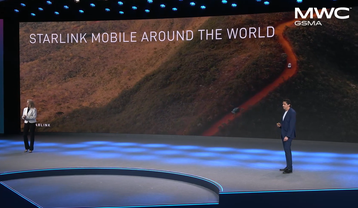
Speaking during a keynote at Mobile World Congress 2026, Michael Nicolls, SpaceX's SVP of Starlink, revealed the operator’s direct-to-cell "Mobile" brand that launched back in 2024, recently surpassed 10 million subscribers.

“At the time we started, 20 percent of the land area in the US and 90 percent of the Earth's surface was uncovered by terrestrial mobile connectivity. Starlink Mobile fills in those gaps," Nicolls said. "Now, after 18 months, we fully deployed the first-generation Starlink mobile constellation consisting of 650 satellites and are operating across five continents, and are the largest 4G coverage provider by geographic area in the world.”
The meteoric rise of SpaceXs’ low-Earth orbit (LEO) brand has, according to Nicolls, provided connectivity for more than 16 million unique users across the constellation.
But the Elon Musk-owned firm wants more, with Nicolls detailing the next-generation of Mobile will see Starlink move beyond simple text messaging and video calls to deliver “broadband capabilities to unmodified cell phones, reaching hundreds of millions, potentially more devices as we scale the constellation.”
The Starlink Generation 2 (Gen2) constellation is expected to launch in 2027, with SpaceX aiming to provide “terrestrial-like connectivity. Nicolls likened it to looking and feeling like users are connected to a high-performing 5G terrestrial network.
The company is banking on using S-band satellite spectrum between 2GHz and 4GHz, which it picked up from EchoStar last year.
Beyond spectrum efficiencies, Nicolls said SpaceX was working closely with device and automobile manufacturers to enable the service on as many devices as soon as it launches, which he said is expected in mid-2027, and will be on “most devices in the US.”
The exec told the MWC audience that the second-generation satellite will have 20-times the link performance of the first-generation Starlink system due to its large phase-array antenna that’s five-times the size of the original, offering four-times the bandwidth per beam.
“We'll use 20-by-20 megahertz beams as well as new capabilities like MIMO (multiple-input, multiple-output). We’ll also use 5G NR NTN (non-terrestrial network) standard, which is specifically designed for the satellite-to-user links and will enable improved experience, especially when a user is at the edge of a satellite by something like a factor of 10, offering users download speeds of up to 150-megabits per second, a truly broadband experience," Nicolls said.
Nicolls said Starlink’s second-generation satellite will have nearly 100-times the data density of a first-generation satellite, with the larger phased array supported by some 16-times the number of beams per satellite, providing the overall satellite throughput exceeding 100 Gb/s on download and 50 Gb/s on upload.
“Our goal is to deploy a constellation capable of providing global and contiguous coverage within six months, and that's roughly 1,200 satellites,” Nicolls said. “From there, we'll continue scaling the constellation to add capacity, much like we scale on the Starlink broadband system. This will allow us to offer data and voice services everywhere. We'll also scale the constellation to truly have global coverage, including the polar regions.”
And rather than pitch the product as a means to replace conventional connectivity, Nicolls was keen to position satellite as “complementary to terrestrial networks,” adding: “It cannot provide the data density that terrestrial networks have, but it can augment terrestrial networks in the places where they cannot reach or when terrestrial networks need additional capacity.”
“For example, in Europe we'll have terabits of capacity over the European continent. We can utilize that capacity to cover the regions where terrestrial networks cannot cover, [such as] the top of mountains, in the ocean,” Nicolls said.
Starlink as life‑saving infrastructure, not just rural backhaul
Nicoll’s comments on using Starlink as a means to augment existing terrestrial networks were echoed on stage by SpaceX COO Gwynne Shotwell, who pitched it as a key means to aid in emergency and disaster response.
Shotwell said that during the Palisades Fire in Los Angeles in early 2025, Starlink deployments kept more than 400,000 people connected, sending more than 250,000 text messages and more than 150 wireless emergency alerts.
“This technology is not just for reaching mobile apps and downloading our videos, but it is also a great enhancement for life-saving capabilities,” Shotwell said. “We served the people of Japan after the Kamchatka earthquake in late July, and again with the Aomori earthquake in December. Think about land-based, terrestrial-based connectivity often is the first hit when there is a disaster. That's why the satellite-based capability is a great augmentation for day-to-day, but a critical element of emergency services.”
The SpaceX COO claimed that more than 4.4 million people have connected to Starlink mobile during emergencies and disasters. But one particular emergency the technology has found itself used in is in the war in Ukraine.
Starlink has been in use in Ukraine since the beginning of the conflict – despite rebuffed reports that Musk threatened to cut off Ukraine's access over refusal to sign critical mineral deals.
But more recently, Veon subsidiary Kyivstar launched a direct-to-cell satellite connectivity service using Starlink last November, with Shotwell claiming that some three million subscribers have already come on board.
“We've sent over 1.2 million [text] messages and are pleased to be able to support the Ukrainians in both these ways, with broadband as well as the direct-to-cell Starlink Mobile connectivity," Shotwell said. "We're especially pleased with our relationship with the Ukrainian government to help them during this very difficult time.”
Shotwell argued that even in Europe, where mobile networks are far more ubiquitous than in the US, satellites have a growing role to play. SpaceX is trialing wireless emergency alerts over its 2 GHz spectrum in Barcelona under a test license, inviting MWC attendees to trigger demo alerts at the company’s booth.







Comments