
Nokia mapped out its AI RAN strategy ahead of the start of this year's Mobile World Congress (MWC) in Barcelona, Spain.
The vendor highlighted progress in its partnership with chipset giant Nvidia during its analyst and media event yesterday (March 1).
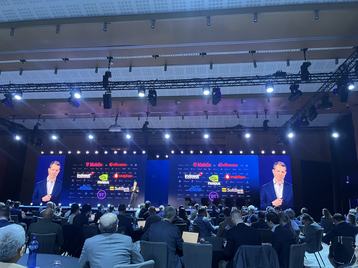
During the event, which was led by Justin Hotard, president and CEO, his first since becoming CEO last April, the vendor set out about how it plans to lay the foundations for an AI-native 6G.
As part of the company's partnership with Nvidia, the pair are working with several telcos, including BT, Elisa, NTT Docomo, and Vodafone Group to adopt AI-RAN technologies that enhance network performance and support the explosive growth in mobile AI traffic.
It comes a few months after Nvidia invested $1bn in Nokia, to support the vendor's plans to ramp up its AI networking focus.
"AI is the new workload reshaping networks. That shift requires architectural change across every layer – including the radio. AI-RAN transforms RAN into a software-driven platform optimized for AI, and with Nvidia and a growing ecosystem of partners, we are progressing from validation to commercial deployment. This is a foundational step toward AI-native networks and 6G," said Hotard.
AI RAN tests
The vendor revealed it has completed functional tests of its AI and RAN workloads on Nvidia's GPU-accelerated AI-RAN platform with T-Mobile US, Indonesia's Indosat, and Japanese carrier SoftBank.
Nokia, T-Mobile US, and Nvidia tested GPU-accelerated AI-RAN workloads at T-Mobile’s AI-RAN innovation center at T-Mobile's Seattle headquarters.
In T-Mobile’s over-the-air (OTA) lab environment, Nokia’s AirScale Massive MIMO radio operating in the 3.7 GHz (n77) band supported user equipment (UEs) running use cases such as video streaming, generative AI queries, and AI-based video captioning.
"By running AI and radio access networks on the same accelerated computing platform, we make sure the network supports business needs – not the other way around. Physical AI requires an intelligent network underpinned by AI‑RAN so operators can fully harness distributed intelligence across every layer of the network," said Ronnie Vasishta, senior vice president of telecommunications, Nvidia.
Nokia said it expects to launch its first commercial AI RAN products next year.
"Now, 2026 is where we will do our first commercial trial, and 2027 is where we will have our first commercial release out,” said Pallavi Mahajan, chief technology and AI officer, Nokia, during a panel.
Hotard assured T-Mobile's CTO, John Saw, that the operator will have trial units to play with this year.
Big demand for AI
Hotard noted that AI already generates traffic with 1.3 trillion annual sessions, made up of what he calls "discrete AI engagements" totaling more than 100 trillion tokens a day.
"What's fascinating about that is it's mobile native. Over half the traffic is on mobile," said Hotard.
He explains that the majority of these AI sessions are human-to-machine engagements, often through chat engagements. "
"They're human-to-machine engagements. They're chatbots, the early stages of agentic and just the incubation of the potential for physical AI. What's coming is machine-to-machine engagement, and when machine-to-machine engagement gets traction and scales, we'll see a tremendous acceleration in the number of tokens, sessions, and ultimately the amount of traffic," he adds.
When analyzing AI data traffic, Hotard noted that it's highly variable and dynamic, as opposed to previous linear traffic patterns in voice, data, and video.

Nokia, AI, and data centers - an opportunity too good to ignore
Better known for its mobile networking business, the vendor wants to cash in on the AI boom
Interconnected data centers
Hotard also noted how the role of the data center is significant in driving this demand for AI use cases.
The vendor has pushed hard on its data center routing and switches offering in the last couple of years.
"Ultimately what transformed AI was data center scale computing," said Hotard, noting that since the launch of ChatGPT there's been a big increase in the investment of scaling out data centers.
"Shortly thereafter, we had another innovation, which was AI factories. And in AI factories, what we realized was that the unit of compute in AI was bigger than just one data center. We needed to have multiple data centers interconnected."
He went on to say that AI is "reshaping the architecture of the network in the data center," while it's also driving increases in investment in transport networks.
As part of Nokia's efforts to support the data center market, the vendor has been selected by Spanish telco Telefónica to deploy networking solutions to back new Edge data center networks across the country.
Nokia’s data center networking solutions will be implemented in its new Edge nodes, providing AI, B2B, and telco cloud services to residential, enterprise, and public sector users. These nodes act as servers for data processing, analysis, and storage – functions that can be performed as close to that data (on the Edge) as possible.
The vendor will deploy networking solutions to support 17 Edge nodes, a dozen of which have already been deployed, including at Telefónica’s flagship Tecno-Alcalá site – one of the largest data centers in the world.
Nokia remains Open, strikes partnership with Ericsson
The theme of Open RAN was also prevalent this week in Barcelona. Nokia, which to some observers hasn't always been the most pro-Open RAN, doubled down on its commitment to the technology heading into 6G.
"I'll just say we're very committed," said Hotard. "You've seen announcements from us around partnerships. We believe that it's going to be an important element of this [6G] investment cycle. Again, back to the whole discussion we're having on architecture, the concept of the glass box and openness and interoperability, we think, is essential. So the short answer is, we continue to be extremely committed to Open RAN."
Such is Nokia's appetite to support Open RAN, the company announced a collaboration with long-term Nordic rival Ericsson.
The partnership will see Ericsson become a member of Nokia’s SMO Marketplace, which is designed to enable telcos and partners to build, integrate, and deploy automation applications within an open, multivendor ecosystem.
As such, Nokia also becomes a member of Ericsson's rApp ecosystem. This is an ecosystem of CSPs, vendors, and independent developers built around the Ericsson Intelligent Automation Platform, Ericsson’s network management and automation platform for open, multivendor, and multi-technology network
"By aligning on open frameworks and intelligent operational models, we are giving service providers a more adaptive and future-proof foundation for automation," said Ali Kynaslahti, CTO, Nokia.
"This collaboration also accelerates the evolution of robust rApp environments that will enable operators to introduce new capabilities faster, optimize their networks with greater precision, and scale innovation across diverse deployment scenarios worldwide."
Nokia, which made a string of announcements during MWC, also updated its radio lineup, with the launch of AI-ready Doksuri Remote radios. DCD's sister publication SDx Central covered this in more detail here.






Comments