
Themed ‘All Intelligence,’ Huawei Connect 2025 was held in Shanghai World Expo Exhibition & Convention Center (SWEECC). During the event, Huawei Digital Power held the Data Center Facility Summit, bringing together over 500 business leaders, technical experts, and ecosystem partners from around the world.
The summit focused on advancing industry intelligence and exploring new green technologies and practices in digital and intelligent infrastructure. At the summit, Huawei Digital Power showcased its all-scenario green solutions and best practices, with an aim to partner with the industry to build high-quality and reliable data centers (DCs) for the AI era.
In his opening speech, Bob He, vice president of Huawei Digital Power, reiterated Huawei's commitment to customer requirements and technological innovation. On one hand, Huawei has simplified O&M with modular design and improved the delivery speed and quality with prefabricated construction.
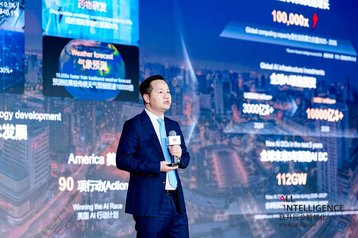
On the other hand, Huawei has integrated digital and power electronics technologies to develop foundational technologies, enhancing product competitiveness across components, architecture, and algorithms.
Mr. He emphasized that AIDCs are propelling infrastructure toward ‘computing factories’ amid the explosive growth of AI computing power.
Efficient and reliable power transmission from grids to chips requires simplifying conversion links and driving innovation in power supply architecture. Thermal management can benefit from a hybrid architecture with adjustable air-liquid ratio to adapt to dynamic AI service requirements.
To meet the demands of the AI era, future infrastructure must be built with AI readiness in mind, turning the unpredictability of traditional data center engineering into productized and prefabricated AIDC solutions. Huawei will intensify R&D investment in power supply, thermal management, and infrastructure to drive continuous innovation.
Additionally, Huawei provides high-quality products and solutions to boost the construction of reliable, agile, and sustainable AIDCs, and works with the industry to thrive in the golden era of intelligent computing.
Steve Kim, president of data center facility & critical power marketing, sales and services, Huawei Digital Power, said at the summit that AI foundation models expedite intelligent transformation of industries and propel the explosion of global GW-scale clusters. The scale of new AIDCs is expected to reach 112GW in the next five years, predicted by authoritative organizations.
Based on the guideline RAS (Reliable, Agile, Sustainable), Huawei continuously innovates in technology and architecture to build comprehensive AIDC solutions featuring all-scenario reference design, highly reliable products & solutions, global ecosystem, and full-lifecycle services, empowering customers to seize the immense opportunities of the AI era:
- Reliable: Safety is the foundation of everything. Ensuring the reliability of DC facilities requires a holistic approach, covering products, architecture, intelligent management, and professional service to build full-lifecycle high reliability.
- Agile: AIDCs demand greater flexibility and agility. High-quality and rapid delivery of AIDCs can be achieved through subsystem decoupling, modular design, preconfiguration, and high-density convergence.
- Long life cycle: Efficient power supply and cooling technologies are adopted to optimize DC energy efficiency. Additionally, the new mode of compute-electricity collaboration is used to further improve the green power usage and dispatching efficiency, contributing to energy saving and carbon reduction of DCs.
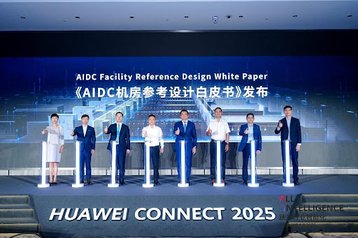
During the event, Huawei released the AIDC Facility Reference Design white paper, which delivers systematic guidance for the standardized design and construction of AIDCs.
The white paper provides an in-depth analysis of challenges faced by high-density cabinets in AIDCs in terms of cooling, power supply and distribution, floor height, and load-bearing capacity, and offers design suggestions across four key dimensions of architectural structure, power supply and distribution, cooling, and integrated cabling, providing multiple reference design solutions for AIDCs based on different power densities.
At Huawei Connect 2025, Huawei Digital Power demonstrated its innovative green and low-carbon solutions on F03, Hall 2, SWEECC across three key scenarios: efficient power consumption, electrification, and low-carbon power generation.
During the event, Huawei released the AIDC Facility Reference Design white paper, which delivers systematic guidance for the standardized design and construction of AIDCs.
The white paper provides an in-depth analysis of challenges faced by high-density cabinets in AIDCs in terms of cooling, power supply and distribution, floor height, and load-bearing capacity, and offers design suggestions across four key dimensions of architectural structure, power supply and distribution, cooling, and integrated cabling, providing multiple reference design solutions for AIDCs based on different power densities.
At Huawei Connect 2025, Huawei Digital Power demonstrated its innovative green and low-carbon solutions on F03, Hall 2, SWEECC across three key scenarios: efficient power consumption, electrification, and low-carbon power generation.
At the data center facility exhibition area, Huawei focused on efficient power consumption by applying the guideline RAS to develop optimal solutions for power supply, distribution, and thermal management in large-scale AIDCs as well as one-stop inference platforms.
Huawei FusionPower series reconstruct power supply links, optimize key nodes, and implement proactive O&M based on the AI predictive maintenance technology, providing highly reliable power for AIDCs.
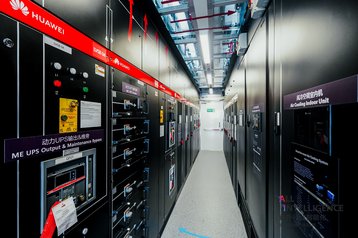


Huawei Liquid Cooling Thermal Management Unit (TMU) adopts the dual-AC/DC architecture to ensure seamless switching between active/standby power supplies.
Huawei's smart modular data center solution FusionModule2000 supports hybrid deployment of servers for both general purposes and intelligent computing and a power density of up to 50kW per rack using the air cooling solution, facilitating efficient deployment, simplified O&M, and stable operation in AI inference scenarios.
It integrates UPS, lithium-ion batteries and cooling systems into a single 40-foot container, delivering a capacity of up to 2.4MW.
With a productized engineering design, the PowerPOD is prefabricated and pre-commissioned in the factory, ensuring standardized, high-quality delivery and providing reliable, uninterrupted power for AIDCs. This solution also reduces time-to-market from 28-18 weeks, enabling rapid response to surging computing demands.
The 10th Huawei Connect provides an in-depth look at Huawei's latest strategic initiatives of its All Intelligence strategy across three dimensions: strategy, technology, and ecosystems.
With ongoing improvements in computing infrastructure and rapid progress in model deep reasoning and multi-model fusion technologies, application scenarios and value of AI are shifting from quantitative growth to qualitative transformation.
By continuously investing in innovation and integrating digital and power electronics technologies, Huawei Digital Power aims to build a robust foundation for intelligent computing that enables more computing power from each watt and foster industry-wide collaboration to build a better, greener future.
More from Huawei
-

Sponsored Huawei all-optical access session: Boost computing with fiber – 10 Gbps all-optical broadband ushers in a new era of inclusive AI
Huawei Connect 2025 demonstrated Huawei's commitment to advancing the F5G-A 10G all-optical network industry in a rapid, sustainable, and resilient manner
-

Huawei announces annual release cadence for three new Ascend AI chips, unveils ‘supernode’ offering company says will outperform Nvidia’s NVL144
Announcements made at company’s Huawei Connect conference in Shanghai
-
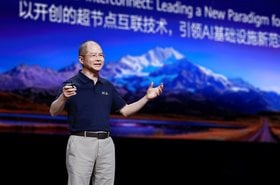
Sponsored Huawei unveils world's most powerful SuperPoDs and SuperClusters
Huawei's deputy chairman of the board and rotating chairman, Eric Xu, has announced the world's most powerful SuperPoDs and SuperClusters at Huawei Connect 2025
Comments