
Huawei announced plans to release new versions of its Ascend AI chips annually up to 2028, with the aim of doubling the compute capabilities with each launch.
The roadmap was unveiled at the company’s Huawei Connect event taking place in Shanghai this week. The Chinese tech giant said it would release its Ascend 950 chip – the successor to its 910C AI chip launched earlier this year – in 2026, with the Ascend 960 and Ascend 970 to follow in 2027 and 2028, respectively.
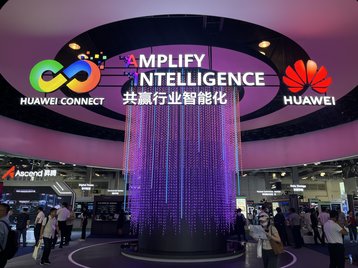
Huawei also unveiled its new SuperPod technology to connect thousands of Ascend AI chips in a single cluster, described by the company as a ‘supernode.’ Billed as the successor to the Atlas 900, also known as the CloudMatrix 384, which comprises 384 910C chips, the Atlas 950 will be launched in the fourth quarter of 2026, supporting 8,192 Ascend chips per node, ultimately totaling more than 500,000 processors.
Speaking at Huawei Connect, rotating chairman Eric Xu said the Atlas 950 cluster would offer 6.7 times more compute power than Nvidia’s forthcoming Vera Rubin NVL144 rack-scale platform, announced earlier this month and set to offer 7.5x more AI performance than GB300 NVL72 systems, as well as 100TB of fast memory and 1.7 petabytes per second of memory bandwidth in a single rack.
Xu went on to say that the Atlas 950 supernode would also have 1.3 times the compute power of Elon Musk’s xAI Colossus supercomputer. This release will be followed by the launch of the Atlas 960 in 2027, which will connect 15,488 Ascend chips per node, with the full supercluster comprising more than one million chips.
The announcements from Huawei coincide with China’s Internet regulator issuing a directive to large Chinese tech companies to cancel orders of and stop testing Nvidia’s RTX Pro 6000D chips, an AI inferencing chip designed specifically for the Chinese market.
A month prior, the Chinese government mandated publicly owned domestic data center companies to source more than 50 percent of their chips from domestic producers. That directive came after the government made claims that Nvidia’s H20 chips – a less sophisticated version of Nvidia’s H100 processors – posed a national security threat, expressing concerns about backdoor access being inserted into the semiconductor.
Speaking during a press conference in London on September 17, Nvidia CEO Jensen Huang said: "We can only be in service of a market if a country wants us to be. I'm disappointed with what I see, but they have larger agendas to work out between China and the United States. And I'm patient about it. We'll continue to be supportive of the Chinese government and Chinese companies as they wish."




Comments