

India has emerged as APAC’s second-largest data center market with 1.6GW of capacity, according to Cushman and Wakefield’s Global Data Center Market Comparison 2026 report.
The country is also in the top three in the world in terms of its development pipeline, with 3.1GW of construction planned. This trend is anchored by Mumbai, which is expected to surpass 1GW of capacity by the end of 2026. This makes Mumbai not only India’s but one of Asia’s fastest-growing data center hubs.
However, there is a lot of room for growth. India’s data center market remains structurally underpenetrated, with vacancy levels declining to 12.9 percent in Q4 FY25. Furthermore, India produces 20 percent of the world’s data, yet houses only three percent of its data centers, approximately 150 out of an estimated 11,000.
These numbers, amongst other calls to gain ‘sovereign’ control over the country’s data, are what prompted the Indian government to take action. When India’s finance minister, Nirmala Sitharaman, announced the country’s FY27 budget, she announced a major policy initiative to encourage the buildout of digital infrastructure in India. A tax holiday till 2047 for eligible foreign cloud service providers.
Understanding the policy
The policy provides a complete tax exemption to foreign cloud service providers in specific situations, given these criteria:
- The Foreign Entity is notified and approved by the Central government upon an application
- The physical data center is owned and operated by an Indian entity
- The data center is approved by the Ministry of Electronics and Information Technology (MeitY)
- The services are being provided to global, non-Indian clients.

However, if the cloud service provider, such as AWS, wishes to serve Indian customers with a new data center in India, it will have to do so via an ‘Indian reseller entity,’ and such revenue will not be tax-free.
Moreover, how will the Indian operator entity (that will likely be a subsidiary of the foreign entity) be taxed? Well, the government has laid out a special 15 percent safe harbor margin for the related data center entity. This means that the local operator can maintain a profit margin of 15 percent over operating expenses, completely bypassing any subjective valuation procedures, with the guarantee that tax authorities will accept the return without initiating any transfer pricing dispute.
This safe harbor margin, however, does not apply to the Indian reseller entity, and the standard operating procedure around that is yet to be seen, with it likely that any services provided to Indian firms will be taxed at the full corporate tax rate.
Hence, the complex tax mechanics aside, this provides clear insight into the government’s goals. Beyond the planned 3.1GW of digital infrastructure, the government is thinking long-term to make India a digital infrastructure hub for the world. They hope that this tax holiday incentivizes firms to set up more infrastructure here to service not only Indian but also global clients, which would simultaneously allow service providers such as AWS to service their Indian clients using domestic capacity.
Why does this matter for the economy?
The investment will bring jobs into the economy, with the Union Minister of Science and Technology, Dr Jitendra Singh, stating that the sector will generate 100,000 engineering jobs. Though the timeline and calculation behind this number are unknown, it is not unusual to think that this buildout will generate massive employment opportunities for India and the Mumbai region in particular.
However, there is a point of contention. Studies conducted in the US reveal that counties that receive their first large data center see total private employment jump by four to five percent over five to six years. This includes positive impacts on construction jobs and information technology sector jobs. While temporary employment such as construction jobs is important for India, with its large unskilled workforce, the real economic value lies in permanent IT jobs that can continue to contribute to productivity even after the initial buildout phase.
The research reveals that wages rise three to four percent for both existing and new workers. However, it also showcases a critical distinction between hyperscale and colocation data centers. Hyperscale counties see large information sector gains while colocation counties do not. A hyperscale campus creates demand for IT contractors, firms that lease space nearby to manage the campus. A colocation facility that simply leases space to remote tenants does not face the same requirements. Moreover, counties with four or more data centers see the most gains in information sector employment.
This data therefore allows for two critical conclusions. First, hyperscale data centers are (mostly) better from the lens of economic development. Second, four or more data centers are the critical mass required to create an ecosystem and a makeshift ‘network effect’ to enable a boom in information sector employment.
When evaluating India’s policy from this lens, we see strides in the right direction. An S&P Global article from 2025 stated that more than 95 percent of the data center capacity increase in India over the next five years is expected to come from leased facilities (colocation).
This is definitely not a good sign for employment, and the policy makes a lot more sense. It is an attempt to attract cloud service providers (hyperscalers) such as Amazon, Meta, Google, and the rest to set up shop in India and service not only local but also global demand, while creating long-term employment opportunities to support the region’s economic development.
The policy seems to already be working, with Meta recently announcing a plan to lease a 168MW facility from Reliance Industries to bolster their global infrastructure.
The challenges of the buildout
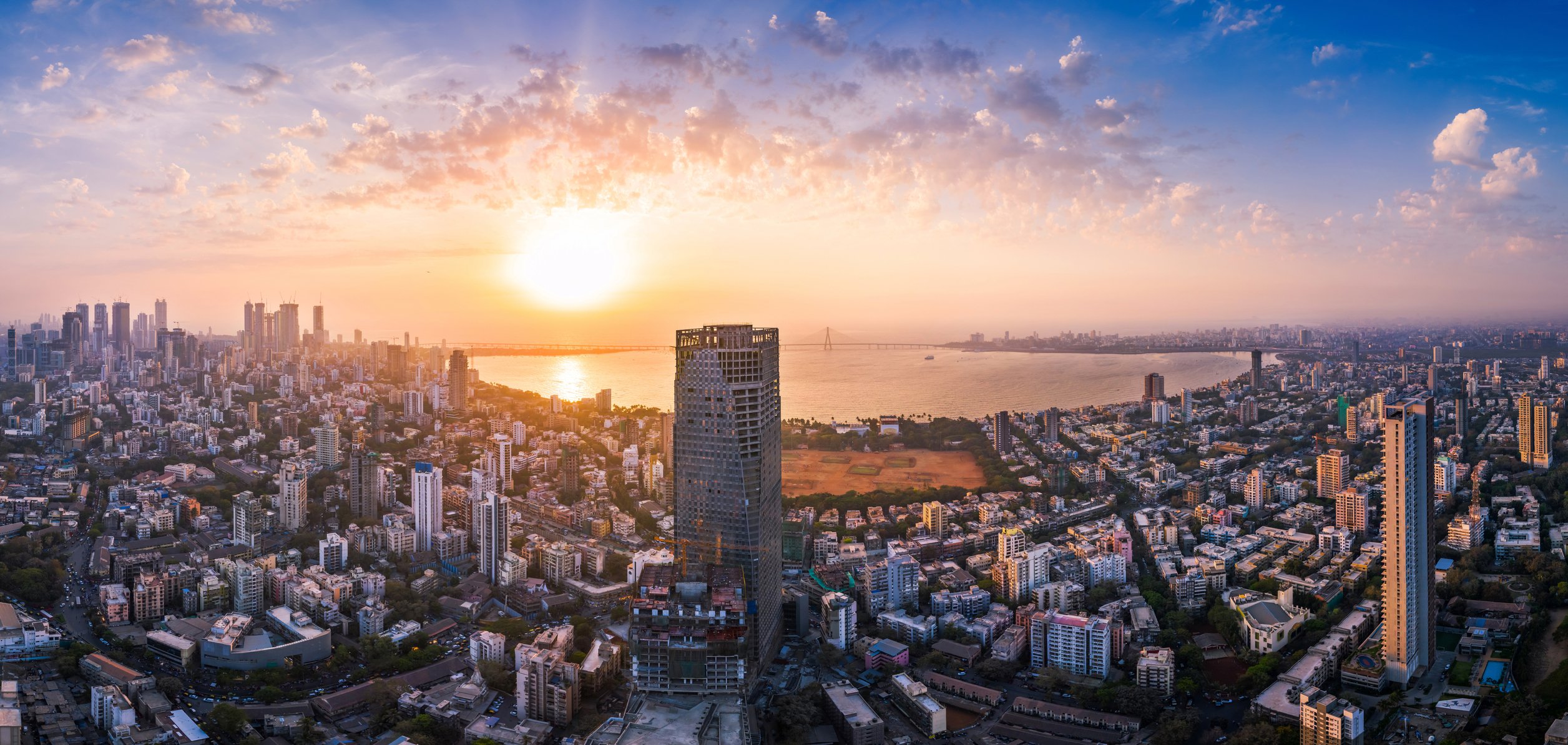
As we discussed, Mumbai is the hub for India’s data center operations. It also has the highest concentration of subsea cables landing in the country, often called the gateway for digital infrastructure in India. This is precisely why a lot of the investment that the government is attempting to spur will flow into Mumbai and its neighboring cities, such as Navi Mumbai.
However, this brings with it many environmental and socioeconomic challenges. There are three key things any data center needs: land, electricity, and water. Due to Mumbai’s geographic limitations, including its tapering shape and expensive land prices, much of the data center buildout has shifted to the Thane and Navi Mumbai regions.
In Panvel, a region near Navi Mumbai, 3,500 families were set to be rehabilitated in 2015 to facilitate the construction of data center projects. However, even as of 2025, thousands of these families continue to live in precarious conditions, with a lack of electricity or a stable water supply. Acquiring land, even in suburban regions, requires meticulous planning and rehabilitation efforts to ensure that the region experiences economic development, not displacement at the expense of the data center buildout.
Furthermore, Adani Electricity Mumbai Limited (AEML), one of the city’s major power providers, has projected a sharp increase in the electricity required by the region, from 50MW in FY23 to 638MW by FY27. With a large majority of this increase, 354MW, coming from data centers, this rise in demand must, of course, be fueled by some source. AEML has planned for the Dahanu power plant, which runs on coal, to aid round-the-clock electricity generation.
This has negative implications for the environment, with many Indian cities facing Air Quality Index (AQI) troubles already. Recently, 40 Indian cities took the top 40 spots in the worst AQI rankings in the world. But it has even deeper socioeconomic impacts on the underprivileged sections of society.
Many low-income neighborhoods in the Mumbai region supplied by AEML report frequent outages and rising bills. With such a massive buildout planned in the coming years, India cannot afford to plan its power buildout alongside. The country has made massive strides in the right direction, ranking third globally in renewable energy capacity installed. India achieved the milestone of 50 percent of its installed capacity from non-fuel sources in June 2025, five years ahead of the 2030 target. These are positive signs that must continue to show results over the next five-10 years if India is to emerge as a hub for sustainable digital infrastructure.
Lastly, digital infrastructure requires water. Mumbai is currently at the center of one of its worst water shortages to date. Less than seven percent of water stock was left in reservoirs as of June 29, 2026. This is significantly lower than 39.5 percent on the corresponding day last year. Concerns due to the city’s delayed monsoon and forecasts for strong El Niño conditions have caused the government to impose a 10 percent water cut in Mumbai since May 15, alongside a 20 percent water cut for industrial and commercial establishments starting June 17.
These conditions may seem like a one-off event but are symbolic of a structural problem. Mumbai’s growing population and strained water supply are not a new story. The addition of water-intensive data centers will only complicate the situation further. Many firms operating in the region, such as STT, Nxtra, and Adani, claim to use air-based chillers to cool their data centers in water-stressed regions. Others, such as Microsoft, claim to offset their water use in a region by replenishing or restoring water elsewhere. However, this does not consider the requirements of a specific region and its population. Replenishment in another region cannot compensate for the strife of the villager who is unable to obtain clean water for his family.
We must learn from the past. Stories from Loudoun County, Virginia, and Phoenix, Arizona have shown how miscalculated implementation can lead to pushback. From 2023-2025, organized movements in Virginia successfully lobbied for stricter noise ordinances, moratoriums on new construction, and enhanced environmental review processes. Across the US, $64 billion-worth of data center projects have been blocked or delayed amid local bipartisan opposition. These stories present warning signs to the Indian government and hyperscalers alike.
A buildout that expands too fast for its own good is negative in the long run. Slow, sustainable, eco-friendly growth prevents local opposition and maintains balance between residents and shareholders. India must chart its own path, hopefully learning from these events.
While the Indian government’s new tax-holiday policy to promote data center buildout by hyperscalers may be viewed positively from the lens of economics and promoting ‘sovereign’ processing of Indian data, it fails to account for the severe socioeconomic and environmental consequences that come along with expansion. India’s move to renewable energy has been staggering over the past few years; however, an accelerating AI buildout threatens to derail India’s push towards the right direction. A need for speed must not result in shortcuts.
The policy could be improved with specific guardrails that acknowledge India and, specifically, Mumbai’s precarious environmental and socioeconomic state. Some examples include mandates on a percentage of energy sourced having to be renewable, a hard limit on water usage in water-stressed regions such as Mumbai, and incentivizing usage of other cooling technology via a taxation on usage of water.
Thanks to its large population, existing infrastructure, and favorable policies, Mumbai is becoming not only India’s but one of Asia’s largest digital infrastructure hubs. This buildout is incredibly meaningful for the region, yet must be approached with extensive guardrails to create positive economic impact while minimizing negative sociopolitical and environmental consequences.


Comments