

Modern data centers bear almost no resemblance to the power-hungry, water-wasting facilities of the past, but public perception hasn't caught up. The result? Essential digital infrastructure gets blocked by fears that no longer reflect reality.
It's time to close that gap with facts about what these facilities actually do today. See how five of the most common complaints against data centers in communities stack up against reality.
1) Data centers are draining our grids
The International Energy Agency estimates that data centers have used between one and 1.5 percent of global electricity in recent years. That number is poised to grow with the rise of AI. But the narrative of endless consumption misses the efficiency revolution happening inside these facilities.
Ten years ago, a facility running a power usage effectiveness (PUE) of 2.0 meant half its power was lost to cooling and other overhead. Today's story is dramatically different:
- Most major centers now operate between 1.1 and 1.2 PUE – meaning 90 percent of power goes directly to computing through AI-managed cooling, direct liquid cooling to chips, and smart monitoring systems.
- Some hyperscale facilities achieve PUE below 1.1, approaching theoretical efficiency limits.
Beyond efficiency gains, data centers actually strengthen electrical infrastructure rather than strain it:
- Data centers pay for needed grid upgrades, which benefit all energy customers using that grid, improving reliability and capacity for homes and businesses.
- Power purchase agreements drive new solar and wind development, with many facilities contracting for renewable energy that exceeds their own consumption.
In a growing number of cases, the net result is more green energy flowing to the grid than the sites themselves consume.
2) They consume astronomical amounts of water
Traditional data centers use evaporative cooling, which can require millions of gallons of water per day. On the other hand, closed-loop systems continuously recycle water with minimal loss to evaporation.
Some advanced centers employ water-free cooling methods, such as air-cooled chillers combined with onsite thermal storage or direct liquid cooling, which can reduce water usage by over 95 percent. The industry now tracks water usage effectiveness as a design metric, with the goal of zero water consumption.
Modern data centers increasingly use these closed-loop air-chilling systems, not older evaporative methods. These new facilities are sometimes called zero-water data centers because once the closed-loop cooling systems fill up, they use very little water for ongoing daily operations.
For context: A new 100MW closed-loop data center built on 100 acres consumes around 8,000 gallons of water daily. A 100-acre residential subdivision with 300 homes would easily consume ten times more water – and industrial uses consume 100 times the data center figure.
The Department of Energy reports that annual irrigation for a modest farm matches the yearly usage of a large facility. So while stewardship is necessary, calling data centers the main water problem misses the broader context.
3) They’re unbearably noisy
Data centers can give off a persistent, low-frequency humming sound due to the massive HVAC and generator systems needed to maintain uptime. Modern data centers, however, are designed with noise mitigation as a core requirement from day one.
Data centers must comply with comprehensive local noise ordinances, with studies and ongoing monitoring required before final project approval. New builds feature acoustic baffles, sound-dampening design, and variable-speed fans that only run when needed. Projects include landscaped buffers, berms, facade enhancements, and distance requirements from homes to preserve neighborhood aesthetics.

For communities, demanding stringent decibel limits at the property line is a completely reasonable expectation, and one that responsible data center operators are now meeting through superior design and engineering.
4) They are ugly, job-poor boxes on valuable land
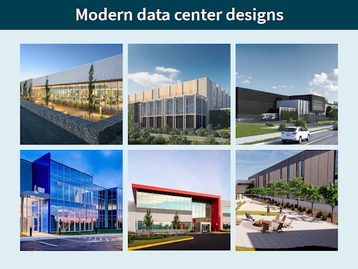
The old stereotype of a giant, blank box is fading. Architects now use landscaping and creative design so facilities fit into their surroundings. As for jobs, while only 30 to 50 full-time staff are typical, those roles are highly skilled and well paid. The broader economic impact includes:
- Six indirect jobs created for each direct data center position in engineering, construction, security, and logistics.
- Hundreds of construction jobs lasting a year or more per site.
- Capital investments of $15-20 million per megawatt built, expanding tax bases to fund schools, roads, and services.
- Significant tax revenue – one Illinois project will generate $4.5-9 million annually in utility taxes alone.
- Millions in school funding without adding students, plus developer-funded infrastructure.
- Tech business attraction through low-latency networks, creating innovation hubs.


6) They don’t benefit communities
Modern operators focus on integration, not isolation. One clever idea is capturing waste heat from servers. In colder climates, this energy now warms nearby buildings, greenhouses, and entire heating districts. Net effect? Less fuel burned and lower carbon footprints.
Large campuses are built out gradually over many years, allowing infrastructure and the community to grow responsibly alongside these investments and demonstrating commitment to the community. Developers increasingly offer direct community amenities such as parks and public spaces, enhancing quality of life beyond monetary contributions.
Community concerns should be matched with facts and direct engagement. By design, today's centers are more efficient, more resilient, and more in tune with their neighborhoods than ever. Don't let outdated perceptions derail your next project.
Contact us to turn community skeptics into supporters with facts, superior design, and measurable local benefits.
More from JLL
-

Sponsored Community-first data centers: Why relationship building is the new competitive advantage
Strategic guidance for operators navigating local engagement in an era of rapid expansion
-

Sponsored Data center success beyond AI: Strategic recommendations for new facilities
Expert advice for navigating the full spectrum of computing needs
-

Sponsored Want to fix the data center talent crisis? Stop hiring for yesterday's jobs
We need to stop hiring for yesterday's requirements and start building teams for tomorrow's challenges
Comments