
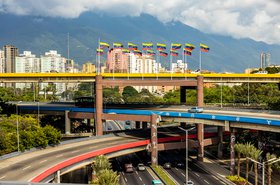
Freespace optics startup Taara is deploying a wireless network in Rio de Janeiro, Brazil.
As part of a new partnership between the City of Rio de Janeiro and X Development, Google's research and development lab, Taara aims to implement the first global mesh network of high-speed optical wireless links.

The initiative aims to offer fast, broad, and secure connectivity to schools, hospitals, and public buildings in Rio de Janeiro. The aim is to reduce Internet access gaps across the city and ensure efficient and affordable connectivity for essential services such as education, health, public administration, and emergency situations.
Launched in 2017, Taara is a moonshot project for connectivity at X, with the aim of supporting global access to quick and affordable internet connections. It uses optical laser technology from X's failed Loon project, which tried to deliver Internet connectivity via high-altitude balloons.
Taara’s Lightbridge product transmits information between terminals at speeds of up to 20 gigabits per second across up to 20km as a very narrow, invisible beam of light. The company says each unit consumes around 40W.
In Rio de Janeiro, Taara plans to install more than 20 optical wireless links to expand access to connectivity in areas where Internet service is unstable, limited, or non-existent. These links will form a mesh network connecting different parts of the city.
Despite Brazil occupying a prominent position among the world's five largest digital economies, Internet access still suffers from significant inequalities. More than half of the population relies exclusively on smartphones to connect, and the quality of telecommunications infrastructure varies widely between regions and communities.
Taara has helped provide Internet services in more than a dozen countries, including Australia, Kenya, and Fiji, and has been involved in trials with Liquid Intelligent Technologies in Congo, as well as with Bluetown in India and Digicel in the Pacific Islands. Other previously announced users of Taara include Liberty Networks in the Caribbean and Bharti Airtel in rural India. Vodafone recently tested using Taara nodes on drones in Spain for emergency situations.
T-Mobile has also used Taara in the US during two large-scale events: the Albuquerque Balloon Festival and Coachella. Taara was equipped to a mobile cell tower on wheels (aka a COW) at the balloon festival, and a tower disguised as a palm tree at Coachella.




Comments