
Satellite imaging company Planet has announced the development of radio communications systems to support hybrid space-to-ground and space-to-space connectivity.
Planet said that the communications systems, which are already patented, use crosslinks to “task satellites within minutes,” with use cases in disaster relief, security, and civil government.
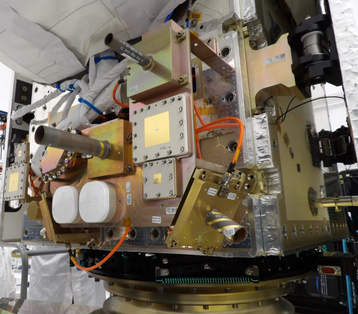
The company said it has rapidly developed this technology and already demonstrated its use with on-orbit testing using its Peliocan satellites. So far, testing has centered around reducing the time between a customer’s request to task a satellite, image acquisition, and insight delivery.
One central aspect of this is a real-time communications (RTComms) system in the form of a C-band radio, supplementing Planet’s ground station telemetry, tracking, and command infrastructure for high priority image tasking updates. This system is still in the research and development phase.
“Utilizing an array of small antennas working in tandem, RTComms achieves a larger field of view to a satellite relay in geostationary orbit, facilitating continuous, uninterrupted communications link availability through Planet’s satellite maneuvers in low Earth orbit,” the company said in a blog post.
Planet said it has also developed a solution to provide data downlink opportunities globally, using its existing infrastructure. High Speed Downlink 3 (HSD3) is a small satellite high-bandwidth data downlink pipeline, which, according to Planet, can reach speeds of up to 10Gbps to its ground stations and allows satellite-to-satellite communication links.
The satellite company also plans to implement a higher power, mechanically steerable Ka antenna to track Ka-band Inter-Satellite Link relay satellites at increased data rates.






Comments