
Self-powered floating data centers that can also act as power plants and water treatment facilities are being pitched by a new company, Optimal Transit.
The firm, a joint venture between naval systems developer InMar Technologies and power technology firm OptiFuel, has unveiled its Kraaken range of data centers, which it says will offer capacity of between 10MW and 100MW.
A second iteration of the design will add power generation and water treatment capabilities, alongside 60MW of compute space. Optimal Transit says this will make it ideal for areas hit by natural disasters.
Unleash the Kraaken
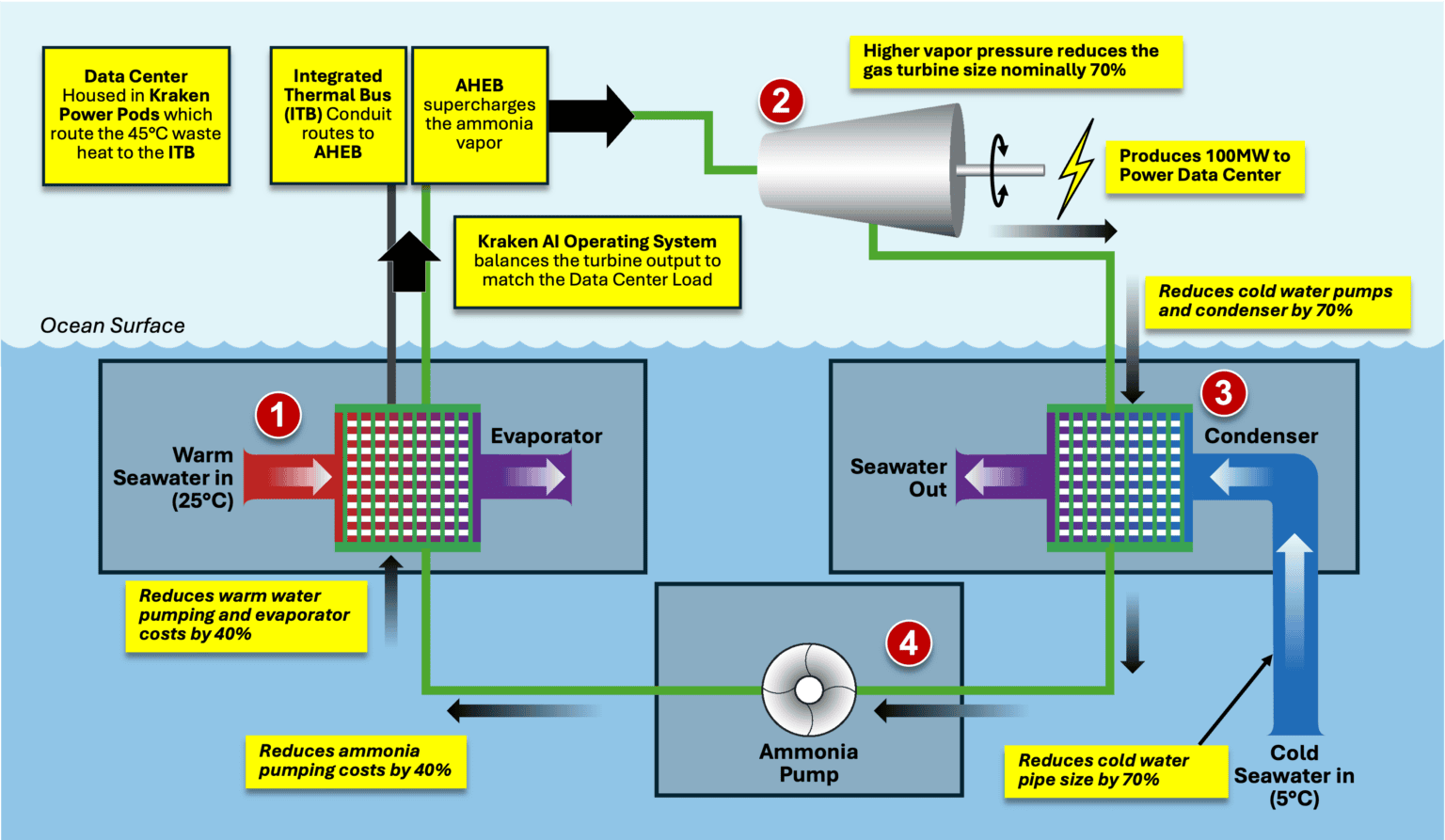
Rather than relying on grid energy, Kraaken will apparently generate its own continuous electrical power by “combining the thermal energy naturally stored in the ocean with waste heat produced by the data center itself.” This is done using the company’s patented multi-stage Digital Ocean Thermal (DOT) engine.
“Artificial intelligence is creating unprecedented demand for power, water and land,” said Scott Myers, president of Optimal Transit. “Kraaken takes a fundamentally different approach by moving data center infrastructure offshore and using proven marine engineering together with our patented DOT technology to produce continuous electrical power.
“Our innovation is not dependent on new scientific breakthroughs – it’s built on integrating commercially proven technologies into a standardized platform.”
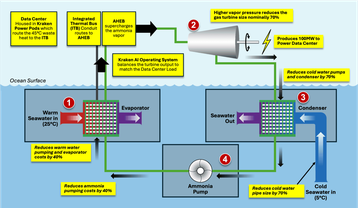
Optimal Transit said the DOT engine incorporates multiple-stage Rankine cycle technology, enthalpy recovery logic, supercharging, and green ammonia (NH₃) synthesis to maximize thermal efficiency and provide reliable, carbon-free baseload electrical generation. The system is designed for continuous operation 365 days per year in marine environments ranging from equatorial waters to Arctic regions without requiring conventional fuel deliveries for data center operations.
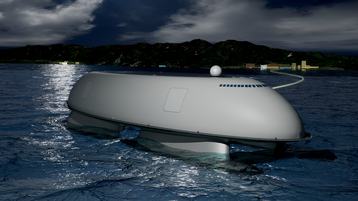
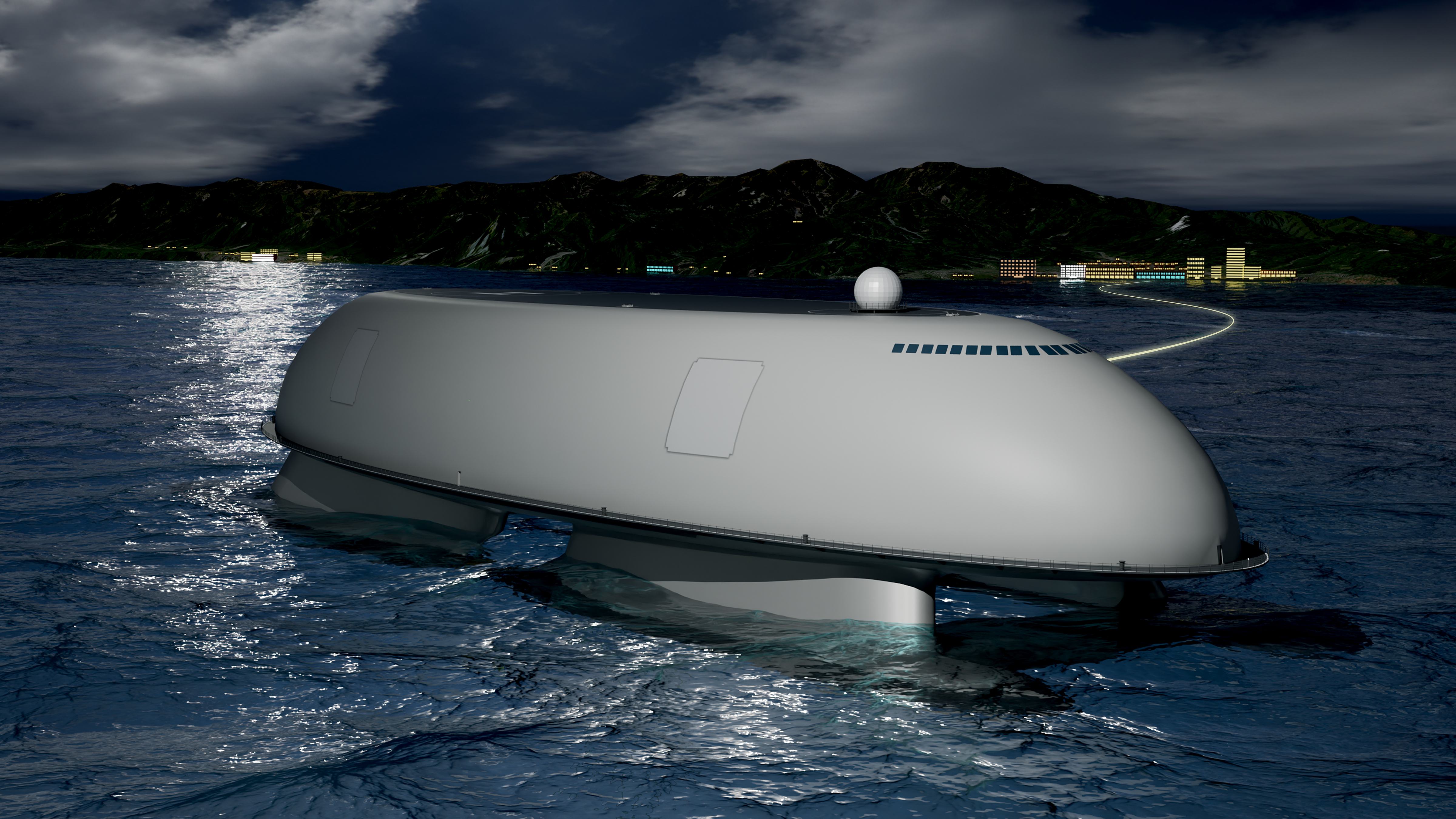
The design of its vessels is based on small waterplane area twin-hull blueprints, which it hopes will provide “exceptional stability for hyperscale computing while supporting continuous high-bandwidth optical and satellite communications.”
It is designed to operate either permanently moored offshore or independently at sea. If severe weather threatens, a platform can disconnect from its mooring and relocate under its own propulsion at speeds approaching 16 knots, allowing uninterrupted operation while avoiding major storms, Optimal Transit claims.
Apparently, the 100MW system can be built for less than $500 million, excluding the cost of compute hardware, a significant saving on the $900m-$1.5bn it costs to build a 100MW facility on land.
Not just a data center
Not content with bringing what sounds like a highly ambitious product to market, Optimal Transit has also revealed designs for Blue Economy Vital 100MW Kraaken, a version of its 100MW floating data center that can also generate power and provide clean water.
By reallocating resources, the company says the machine is capable of providing up to 40 MW of continuous clean baseload electricity that can be exported directly to shore, enough to reliably serve 32,000 homes.
The machine will also be able to deliver 30 million liters (7.9 million gallons) of fresh water per day – enough to support an estimated 150,000 people – produced using vacuum-flash desalination, a water purification process that can use waste heat.
This will leave 60MW spare for use as AI compute capacity. All three outputs – power, water, and compute – flow to shore through a quick-disconnect umbilical system. If conditions require it, the vessel disconnects and relocates within hours. When conditions clear, it reconnects.
Optimal Transit says the machine could be deployed in disaster-hit regions where power and clean water are scarce.
Jeff Kline, president of InMar Technologies, said: "The Vital 100 MW configuration takes the same core capabilities and asks a different question: what happens when you point some of that output directly at a coastline that doesn't have reliable power or clean water? The answer is a single vessel that can serve the equivalent of a small city – indefinitely, from offshore, with no connection to the existing grid."
InMar Technologies, which is based in Maryland, develops advanced marine technology for clients including the US Navy.
South Carolina-headquartered OptiFuel makes zero-emission energy systems for transportation and industrial markets, specializing in rail, marine and power generation. Neither company appears to have any experience developing products for data centers.
It is not clear what stage of development Kraaken has reached, DCD has contacted the firm for more details.
Floating data centers are becoming increasingly popular as developers look for ways to bring capacity online fast.
Keppel has started work on a 25MW floating facility in Singapore, due to come online in 2028, while US-based Panthalassa wants to harness the power of waves for floating data centers at sea.
Floating wind firm Aikido has also announced its entrance into the data center space with the launch of a floating offshore wind platform integrated with a modular AI-focused data center.
Other companies working on floating projects include Seatrium, Mocean, and Atomarine.






Comments