
Nvidia has introduced a new scale-across technology, Spectrum-XGS Ethernet, designed to connect multiple data centers to form a unified 'AI super-factory.'
Unveiled at Hot Chips 2025, Nvidia Spectrum-XGS was introduced as a solution to the resource demands of agentic AI, increasingly prevalent AI models that perform tasks autonomously on behalf of enterprises.
Dave Salvator, director of accelerated computing products in Nvidia’s Accelerated Computing Group, said that the increased inference from AI agents is becoming more than a multi-GPU and multi-node problem for today’s networks.
“It is an at-scale challenge to deliver great experiences to many users at scale,” said Salvator.
“Existing data centers or legacy data centers may have fixed power budgets, which means you can get a fair amount of compute into that one data center – but you are probably going to hit a limit in terms of the amount of power you can get in and, in some cases, the amount of heat you can get out.”
Nvidia’s Spectrum-XGS builds on Spectrum-X, the tech giant's Ethernet-based networking fabric specifically designed for AI.

Inside Spectrum-X: Nvidia’s Ethernet networking platform
How Nvidia re-engineered Ethernet to power the world’s largest AI clusters
First revealed in 2024, Spectrum-X fuses Nvidia’s networking hardware and software into an AI-tuned platform, pairing Spectrum SN5600 switches – built on the Spectrum-4 architecture – with BlueField-3 DPUs to boost generative-AI network performance to 1.6 times that of conventional Ethernet fabrics.
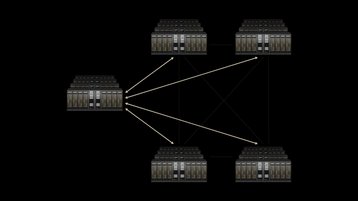
Spectrum-XGS marks the next evolution of Nvidia's Ethernet offering, with Salvator outlining that a new networking algorithm leverages the Spectrum-X infrastructure to enable the effective movement of data across longer distances between sites. The solution integrates Nvidia Spectrum-X switches with ConnectX-8 SuperNICs, the company's AI-centric 800 Gb/s networking adapters.
Nvidia claimed the new Spectrum-XGS nearly doubles the performance of the open-source Nvidia Collective Communications Library (NCCL), which facilitates high-speed communication between Nvidia GPUs.
The chip giant also claimed the new networking platform delivers 1.6 times the bandwidth density of standard Ethernet in multi-tenant, large-scale AI environments.
Salvator described the end result as allowing different data centers to communicate with each other and “essentially act as one gigantic GPU”, or an AI super-factory to use Nvidia parlance.
The term scale across was used to describe the methodology, as an addition to existing scale-up and scale-out architectures.
“We're talking now about multi-data center scale as an enabler to allow more ambitious agentic AI applications to get to the scale that they need,” said Salvator.
With the release, Nvidia is doubling down on Ethernet as the medium of choice for AI workloads.
As covered recently by SDxCentral, Nvidia sought to take the best of InfiniBand and apply it to Ethernet for its Spectrum-X offering.
According to 650 Group, Nvidia’s Ethernet growth has seen the chip giant become the “fastest-growing vendor in data center switching for 2024.”
While InfiniBand still commanded roughly 80 percent of the AI back-end networks market in 2023, recent Dell’Oro Group projections indicate that growing demand for Ethernet-based solutions could generate nearly $80 billion in data-center switch revenue over the next five years.
Most network engineers are more comfortable with Ethernet than with InfiniBand, according to researchers, while the high cost of wiring together countless GPUs will ultimately tip the scales in Ethernet’s favor.




Comments