
Nvidia at CES 2026 is the gift that keeps on giving. After debuting an Edge processing chip and an AI-native storage infrastructure, the tech giant offered one more gift to the networking world: a unified control plane capable of unifying control of large-scale AI infrastructure networks.
Dubbed BlueField Astra, which stands for Advanced Secure Trusted Resource Architecture, it’s a system architecture that combines Nvidia’s flagship BlueField-4 data processing units (DPUs) with ConnectX-9 SuperNICs to provide cluster managers with more refined control over their entire networking stack.
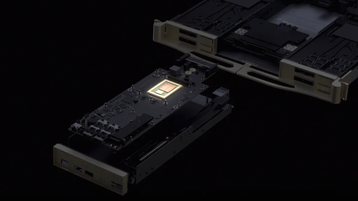
Front-end networks, or north-south (N-S), are directly managed by BlueField DPUs themselves via their control software stacks. But for the backend or east-west (E-W), where multiple GPUs are interconnected at massive bandwidth and ultra-low latency, management can be a little trickier.
BlueField Astra aims to extend control between the DPU and NICs, providing out‑of‑band management and policy enforcement across N-S and E-W traffic in AI clusters, with BlueField‑4’s embedded Arm cores used to host the control plane.
“With BlueField Astra, CSPs can extend their trusted software stack running on BlueField-4 DPUs to securely manage tenant isolation, and network policies across the AI compute fabric,” an Nvidia technical blog explained. “These policies are programmed through the out-of-band DPU port and enforced directly in SuperNIC hardware, ensuring consistent control throughout the system.”

Nvidia pushes AI from edge to storage with Jetson T4000 and BlueField-4 updates
Giant’s CES 2026 showcase sees BlueField reinvent storage while Rubin marches toward production
BlueField Astra features an entirely novel control plane architecture compared to traditional offerings.
Where conventional approaches would see host-based software configure both NICs and fabric, Astra instead isolates the SuperNIC control plane from the host operating system, meaning tenant workloads cannot tamper with or gain visibility into network provisioning.
“With a single point of control anchored in the BlueField-4 DPU, service providers can streamline provisioning, enforce policies consistently, and reduce operational complexity – all without touching the host CPU,” Nvidia’s blog reads.
There’s an added bonus of extra security, too. Given Astra isolates the SuperNIC control plane from tenant workloads, cluster operators can be safe in the knowledge that tenants cannot bypass or alter policies, a potential boon for those running multi-tenant environments.
BlueField Astra also offers support for Nvidia’s DOCA software platform. Due to the control plane anchoring networking, security, storage, and management functions on the DPU, DOCA microservices and workflows can then be safely extended into bare-metal AI systems and the E-W compute fabric, without introducing dependencies on the host operating system.
“By combining BlueField DPUs with SuperNICs under a unified, isolated architecture, BlueField Astra empowers CSPs to confidently build, provision, and secure the next generation of AI infrastructure,” Nvidia’s blog explains.
Astra was one of a host of Nvidia updates at CES in Las Vegas, as the once gadget-focused tech show continues to evolve with the increasing addition of B2B tech.
Among the offerings relevant to the world of networking were Jetson T4000, an Edge-focused graphics card designed to bring real-time AI processing to autonomous robots, to smart infrastructure, and an AI-native storage infrastructure offering, dubbed the Inference Context Memory Storage Platform, or ICMS.
There was also news that Nvidia expanded its partnership with storage market darling Vast Data, with the latter set to add BlueField-4 DPUs as part of its Vast AI Operating System to boost its handling of inference workloads.






Comments