
SpainSat NG II, a Spanish military communications group operated by Hisdesat, a part of Indra Group, has been reported to have suffered a “space particle” impact during the latter phases of its launch at 50,000km, complicating its passage into geostationary orbit.
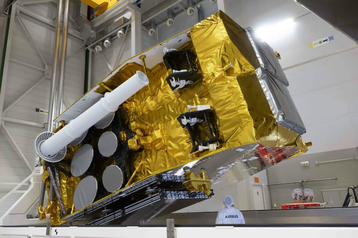
“The technical team is analyzing the available data to determine the extent of the damage,” the company said in a statement. “If necessary, SpainSat NG II will be replaced as soon as possible.”
Indra Group said it had activated its contingency plan to ensure its customers would not be affected by the incident.
The 6,100kg Airbus-built SpainSat NG II was launched on October 23 from Cape Canaveral, built as a result of a 2019 consortium which included Thales Alenia Space, and backed by the Spanish Government. The satellite, and its predecessor SpainSat NG I, were developed to enable secure communications for the nation’s armed forces and government agencies. €2 billion ($2.34bn) of government money went into the construction, launch, and operation of SpainSat NG, which was expected to possess an operational lifespan of 15 years.
“SpainSat NG represents the next generation of secure satellite communications in Europe,” Laurent Jaffart, ESA’s director of connectivity and secure communications, said in a statement following the launch of SpainSat NG II. “This second launch marks a key milestone in providing more adaptable and secure communications services that will benefit governmental users across Europe and beyond.”
An interstellar whodunnit
The satellite was struck while above the geostationary belt, where debris events are less likely, leading to potential causes ranging from an encounter with a micrometeoroid to the charged particle effects satellites suffer from space weather, a phenomenon which usually requires extended exposure to space radiation.
The incident highlights the generally understated lack of awareness and assurance we still possess in the environment of space.
The term “space particle incident” is not common to the industry, and has led many to infer a suspected conjunction with an object too small to be identified and subsequently tracked, an extremely common occurrence in the planet’s orbit.
It is a mainstay of space debris debates that the majority of independent objects hurtling around the Earth’s orbit are untracked, being too small to position with modern technology.
The journal Nature posited in 2024 that 97 percent of debris is untracked, with an estimation that more than one million debris objects of below 1cm currently blitz around the planet invisibly, moving at an average of 10km/s (22,370mph), with some speeds estimated at 15 km/s, ten times the velocity of a bullet, and five times the speed of sound.






Comments