
Microsoft has invested in low-carbon cement manufacturer Fortera to support the development of its flagship cement manufacturing plant in Redding, California.
The investment, made through Microsoft’s Climate Innovation Fund, will also secure Microsoft the right to procure Fortera’s ReAct low-carbon cement product and its associated environmental attribute certificates.
"We are making long-term investments that will help us achieve our 2030 carbon negative goals,” Brandon Middaugh, general manager of sustainability markets and Climate Innovation Fund at Microsoft, said. “Corporate investment can assist in jumpstarting and scaling nascent markets like low-carbon cement. Our team was attracted to Fortera’s approach due to its potential for deep emission reductions, competitive cost targets, and its expected compatibility with existing production infrastructure.”
Fortera produces two cement products: ReAct Blend, which is engineered to be blended with other cement products to enhance early strength and flow, and ReAct Pure, designed as a standalone cement replacement.
The cement is produced through Fortera’s ReCarb process, which the company claims produces cement with 70 percent lower CO2 emissions compared to Ordinary Portland Cement.
According to Fortera CEO Ryan Gilliam, to achieve the carbon reductions, Fortera takes cues from nature, producing a stabilized reactive form of limestone that absorbs CO2 rather than emitting it. The process can be bolted onto existing cement manufacturing plants, allowing the facilities to capture industrial CO2 emissions and convert them into mineral form to achieve a ready-to-use low-carbon cement.
"Microsoft's collaboration with Fortera aligns with our goal to advance novel technologies to commercially available products,” said Gilliam. "Across a range of sectors, Microsoft has played a catalytic role in overcoming market barriers to decarbonization. Their investment highlights the impact our full commercial-scale plant brings to the low-carbon building materials space.”
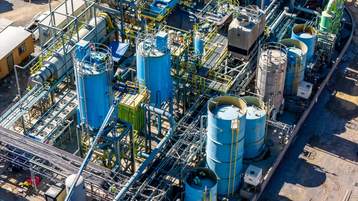
Fortera’s Redding plant reached operational status last year and currently has the capacity to produce 15,000 tons of cement annually while capturing 6,600 tons of CO2 in the process. With the investment from Microsoft, the company expects to scale the plant to 400,000 tons per year.
The company recently announced its intention to launch a Series D financing round for at least $150 million. Fortera said it's looking to raise approximately $500m in project-level financing to fund the construction of five additional manufacturing plants, all of which are expected to be signed within the next year and built out over the next five years.
The five new plants will each cost around $200m to $250m to build and will be able to produce up to 400,000 tons of Fortera cement apiece, according to Fortera’s CEO. The company has said that it will focus on selling its product to companies in the US, Canada, and Australia.
Microsoft has invested in several low-carbon cement companies to support the decarbonization of its data center construction process. In May, the company inked a deal with Sublime Cement to purchase 623,000 tons of its low-carbon cement product from Sublime’s first commercial factory in Holyoke, Massachusetts.
Microsoft has also supported research into lower-carbon concrete mixes. In August, the company's researchers published a paper that tested the potential of reducing the carbon footprint of cement through the incorporation of seaweed.
The company also tested the applicability of lower-carbon concrete mixes in construction projects at its data center site in Quincy, Washington, back in 2023.
AWS, Meta, and Stack have also signed commitments or begun to use low-carbon cement in their construction processes.


Comments