
Amazon has signed a commercial agreement with Brimstone, a low-carbon cement company, to reserve volumes of its cement from Brimstone’s production plant in Oakland, California.
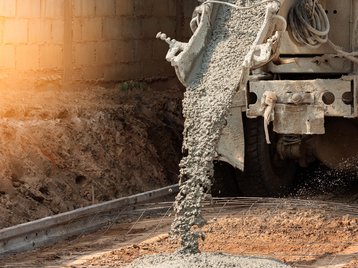
The agreement follows a successful test of Brimstone’s Ordinary Portland Cement (OPC) for its use in construction. The tests were designed in collaboration with Amazon’s concrete consultants to determine the workability, compressive strength, and other key properties of Brimstone’s concrete materials based on Amazon slab mix designs.
Through the testing, the partners confirmed that the OPC performed in accordance with ASTM C150 requirements - the industry benchmark for OPC - and worked well with conventional materials that Amazon uses in its buildings.
"These initial results are encouraging and demonstrate the potential for Brimstone's innovative materials to scale across our buildings portfolio and reduce the carbon footprint of concrete," said Asad Jafry, director of Global Energy, Sustainability & Automation at Amazon.
Due to the success of the results, the companies have set out plans for more extensive testing over the next two years. The tests will evaluate durability, sulfate resistance, aggregate reactivity potential, and other key properties across a broader range of concrete mix designs and applications. If successful, the companies will lock in a future supply of Brimstone’s OPC for use across Amazon’s facilities, including use in data centers.
"Brimstone has developed a more efficient, economical, and sustainable process for producing industry-standard materials that can be used today with standardized, known testing programs, which allows for fast market adoption,” said Cody Finke, co-founder and CEO of Brimstone.
The company’s OPC works by utilizing carbon-free calcium silicate rock and magnesium compounds that naturally absorb CO2 instead of limestone. The product is designed to be chemically and physically identical to conventional cement but carbon negative, offsetting a significant amount of emissions.
The company was founded back in 2019 and has so far raised more than $80 million across several funding rounds. It has secured backing from notable investors, including Breakthrough Energy Ventures, Amazon Climate Pledge, and S2G Investments (formerly S2G Ventures).
At present, cement production is one of the largest contributors to global emissions, accounting for approximately 7.5 percent of the total. The high carbon footprint of cement and its extensive use within the construction of data centers leading several hyperscalers to seek low-carbon construction options to reduce their overall carbon footprint.
In May, Microsoft inked a deal with low-carbon cement firm Sublime Cement for 623,000 tons of its low-carbon cement product. The cement is expected to be delivered over a six to nine-year time frame, with Microsoft providing a priority purchase option in its construction projects if the supply of the cement is geographically possible.
Stack is also testing Sublime's cement at a Virginia data center campus.
Data center developers are additionally exploring the use of mass timber as a means to decarbonize their construction process. Last week, Meta announced it had begun to pilot the use of mass timber in the construction of its data centers, in an attempt to replace the use of steel and other building materials.
Meta erected its first administrative building made from mass timber at its Aiken, South Carolina, data center campus this year.




Comments