
Microchip Technology has expanded its data center solutions portfolio by enhancing its networking and storage offerings to support artificial intelligence (AI) and high-performance computing (HPC) applications.
The additions include the Switchtec PCIe 6.0 Low-Lane-Count (LLC) switch, an updated Flashtec PCIe Gen 5 NVMe 5016 SSD controller, and an enhanced Adaptec SmartRAID 4300 family of NVMe RAID storage accelerators.
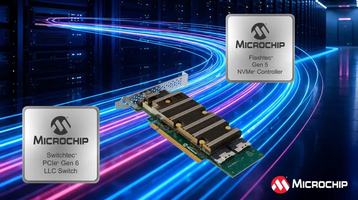
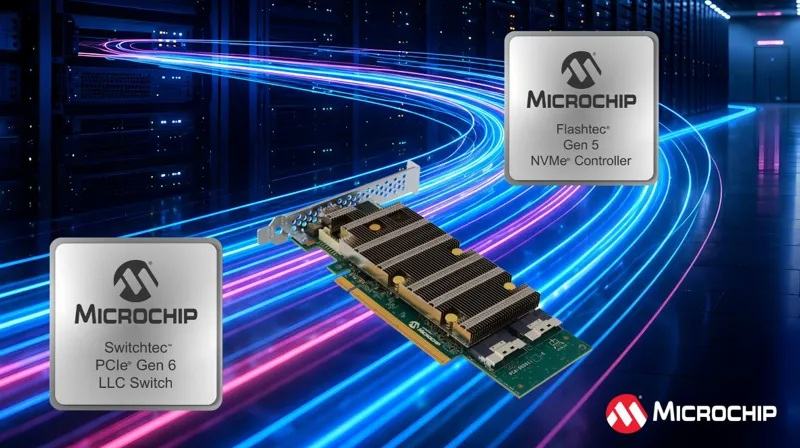
Microchip said the LLC switch has been designed for space- and power-constrained systems, providing up to 64 PCIe Gen 6 lanes and 32 ports, with flexible two-, four-, eight-, and 16-bifurcation options. The switch also incorporates direct memory access technology to support peer-to-peer data transfers between connected devices while reducing host CPU involvement, the company said, adding that it has also extended the same PCIe multicast and partitioning functions to the switch as can already be found in Microchip’s larger PCIe Gen 6 switch product portfolio.
Meanwhile, the updates to Microchip’s storage products will see its Flashtec PCIe Gen 5 NVMe 5016 SSD controller offer advanced virtualization, quality of service management, and programmability, to help optimize performance across enterprise, hyperscale, and AI deployments.
The company’s family of Adaptec SmartRAID 4300 NVMe RAID storage accelerators has also been upgraded, offering improved storage security and data protection, while minimizing downtime. Microchip has further added self-encrypting drives with both local and remote key management in RAID 6 and RAID 60 configurations for increased resiliency and security.
“Customers are looking for technology partners that can address multiple challenges across the infrastructure stack while helping simplify design and accelerate deployment,” said Brian McCarson, corporate VP and GM of Microchip’s data center solutions unit. “By continuing to expand our portfolio, we're providing the building blocks needed to create more efficient, secure, and adaptable platforms for today’s increasingly distributed and data-intensive computing environments.”


Comments