
Latvian Mobile Telephone (LMT) showcased its private 5G network with a host of application demonstrations at the Freeport of Riga earlier this week.
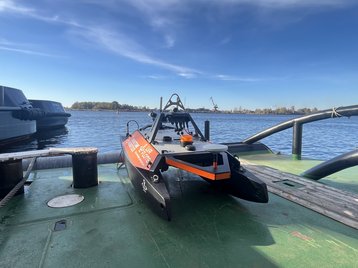
The Latvian telco demonstrated its Standalone 5G private network in a number of use cases, including drone-based crane inspection, underwater drones for water quality inspection and oil spill collection, and unloading and loading dual-use Unmanned Surface Vehicles (USVs).
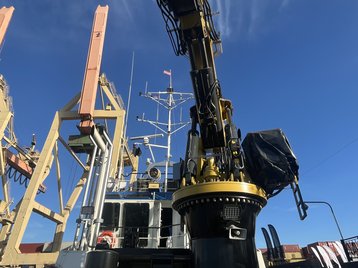
The demonstrations took place at the Baltic Container Terminal within the Freeport of Riga, on Tuesday (October 21), a day before the Techritory conference, which DCD attended.
LMT, Latvia's oldest and largest telco, first launched its private 5G network in March at the Baltic Container Terminal (BCT) within the Freeport of Riga. The company claims it was the first private 5G network in the Baltics.
At the time, the telco explained that a private 5G network was required to replace "outdated" WiFi technology. To support this, LMT installed its 5G core network at the site.
"Maritime connectivity has been an underdeveloped area in telecommunications. At the same time, ports are critical infrastructure of national and international importance, both in terms of supply chain efficiency and national defense," said Juris Binde, president of LMT.
"The LMT 5G core makes it possible to build out on the opportunities presented by 5G, and we’re excited to be able to show just a few of the game-changing use cases that are made possible by our technology."
Some of the demo use cases that utilized LMT's private 5G network included real-time hydrography sensor data transmission from ship to land, using machine vision and AI to analyze irregularities.
Beyond this, automated infrastructure inspections were carried out by drones and analyzed via machine vision in partnership with the autonomous drone platform Beyron.
USVs were also deployed and piloted from a ship in partnership with LVR Flote, while the network supported an underwater intruder detection system used with Submerge Baltic and USV Spark maritime drones, which were again remotely piloted.
In 2023, LMT worked with local technical port services provider LVR Fleet to carry out 5G trials on the Daugava River in Riga.
The 5G network at the port has been integrated with BCT’s existing closed network, ensuring all data transmission remains internal. As noted by Kārlis Vilciņš, head of system integration business, LMT, a push-to-talk solution was introduced instead of radios, allowing both voice communication and image and video sharing.
There's also a data center at the port, which houses all site data.
Delivering on 5G promise
The deployment of the private 5G network at the port exemplifies the point of 5G as a technology, according to Ingmārs Pūķis, vice president, member of the board, LMT.
"At the onset of 5G, one of the promises we took seriously was that 5G was industrial," Pūķis told DCD.
"One of the ideas was that 5G is the industrial standard, because historically 2G, 3G, and 4G have all been mass market standards. But 5G is not needed by consumers."
He explained that LMT is looking to expand its private 5G networks to other key industries, such as agriculture.
During Techritory this week, LMT also revealed that it has signed a memorandum of understanding with the Port of Hamburg and Fleet of Hamburg to "increase bilateral cooperation and digital innovation in maritime technologies in port infrastructure management in the Baltic Sea."







Comments