
Westinghouse and Google Cloud have provided a closer look at their jointly developed AI-powered tool designed to improve the construction of new nuclear power plants.
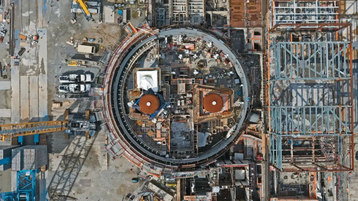
Revealed during a virtual roundtable event, the companies claim that the AI-powered program, which was originally announced earlier in the year, can restore predictability to an industry long hampered by delays, while helping meet soaring US electricity demand driven by AI, data centers, and electrification.
Revealed during a virtual roundtable event, the custom AI platform blends Google Cloud’s optimization engines with Westinghouse’s nuclear-specific models, informed by 75 years of engineering data. The platform combines Westinghouse’s existing HiVE and Bertha nuclear AI solutions with Google Cloud’s Vertex AI, Gemini, and BigQuery technologies.
According to the companies, the model predominantly targets improvements in reducing construction costs, which currently account for approximately 60 percent of total reactor costs.
The platform works by using the WNEXUS digital twin of the AP1000, which the companies claim can automatically interpret design models, generate thousands of construction tasks, simulate real-world disruptions, and re-optimize sequencing in minutes.
Dr. Lou Martinez Sancho, CTO at Westinghouse, framed the partnership as “energy for AI and AI for energy,” arguing that the sector can no longer meet demand using traditional planning cycles.
Raiford Smith, Google Cloud’s global director of Power & Energy, echoed this urgency, noting that energy now “underpins economic growth, data-center expansion and 24/7 carbon-free goals.”
The companies have said that early pilots have shown significant time and cost reductions, replacing week-long manual re-planning cycles with near-real-time adjustments. In one live demonstration, AI cut estimated task cost by about a quarter while keeping crews productive despite supply-chain or weather delays.
Westinghouse describes the approach as a “technology brick,” designed to be reused across licensing, refueling, and long-term operations. Utilities are already exploring similar tools for outage optimization and life-extension programs across the 90-reactor US fleet.
Westinghouse is currently undertaking a significant build-out of its nuclear reactors, sharing with the US government earlier this year plans to have ten of its AP1000 nuclear reactors under construction by 2030. Four of these reactors are likely to be at Fermi America’s planned up to 11GW campus in Amarillo, Texas.
Google has increasingly looked towards nuclear energy as a key power source for its operations. In October, the company signed a 25-year Power Purchase Agreement with NextEra Energy to offtake power from its 615MW Duane Arnold Energy Center in Palo, Iowa. The agreement will support restarting the plant, which has been shuttered since 2020.
Google has also signed several other deals across the nuclear sector. These include a 200MW PPA with Commonwealth Fusion Systems, a nuclear fusion firm, a 50MW PPA with small modular reactor firm Kairos Power, and a strategic agreement with Elementl Power to develop three nuclear energy projects in the US.




Comments