
Satellite firm Globalstar has installed new antennae at a ground station site in Texas.
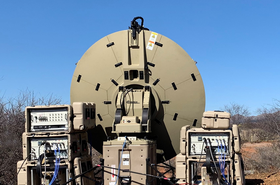
The company recently announced the successful installation of Clifton-8, the first six-meter tracking antenna designed to support the company’s C-3 mobile satellite constellation, as part of its push for global expansion in ground infrastructure to extend its MSS network.

“These upgrades will enhance our ability to track and communicate with satellites more effectively and reliably, increasing network throughput, reducing latency, and ultimately improving user experience,” L. Barbee Ponder, C-3 general counsel and vice president of regulatory affairs, told DCD. “For the C-3 system, this expansion enables broader bandwidth capacity, greater geographic redundancy, and the flexibility to scale services in response to rising customer demand, particularly in data-rich use cases like asset tracking and remote communications.”
The antenna is the first of five intended for installation at the Clifton, Texas, ground station facility, and the first of 90 planned across 35 ground stations spanning 25 countries and territories.
The Clifton site is Globalstar’s largest and longest-operating site, with two decades of continuous service. While the site has been active for most of the company’s 25-year history, Clifton will also be at the forefront of investments into new capabilities to keep up with the advancing state of satellite technology.
“While it’s true that satellite technology is advancing rapidly, Globalstar has taken a proactive and synchronized approach to system development,” Ponder added. “The tracking antennas and associated ground systems are being upgraded in lockstep with satellite advancements to ensure seamless integration and optimal performance. By designing both segments in parallel, we avoid the common pitfall of technological misalignment between orbit and Earth, and maintain a consistent pace of innovation across the full network architecture.”
Globalstar is positioning itself to address critical sectors like emergency response, industrial IoT, logistics, maritime, and agriculture.
“As we scale, our mission remains clear: deliver secure, efficient, and always-on connectivity to the world’s most remote and high-stakes environments,” Ponder said.
Launched in 1991 as a joint venture of Loral Corporation and Qualcomm, Globalstar's first-generation constellation consists of 48 LEO satellites, with an additional four satellites in orbit as spares, while its second-generation comprises 24 machines.
GlobalStar counts Apple as an investor, which uses the satellite firm's services to power some direct-to-cell services on its iPhones.
It has tapped Australian Edge data center firm DXN to deliver three prefabricated modules to Maui, Hawaii, by the end of 2025. The company operates 24 ground station sites globally.
The company also recently announced a new agreement with Telecom Castilla-La Mancha (Telecom CLM) to expand the Alcazar Teleport in Castilla La Mancha, Spain, with additional ground station antennas and associated infrastructure to support the C-3 System. Globalstar will install three new tracking antennas and supporting infrastructure, doubling its footprint at the site.






Comments