
Chinese commercial satellite operator Geespace has launched its latest batch of Internet of Things (IoT) satellites into orbit.
The company, a subsidiary of Geely, has completed its sixth orbital insertion of its 72-satellite constellation, GEESATCOM, launching the 12 satellites to reach a new total of 64.
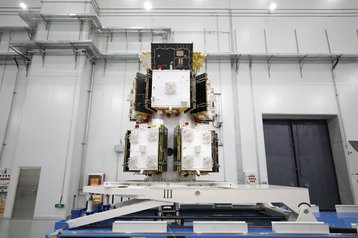
The company boasts a full development and production loop, with satellite design, production, payload, chip assembly, mission control, and terminals all in-house. It claims just one percent of the traditional satellite communication costs, presumably factoring many of the verticalization costs it has taken on, with “reliability exceeding international peers”.
The satellites were all launched with Jielong-3 rockets, sometimes known as SmartDragon-3 rockets, with the final three occurring at sea from retrofitted cargo barges off the coast of Rizhao city in the Eastern province of Shandong, orchestrated by the Oriental Maritime Space Port (OMSP) facility at Haiyang, also known as Dongfang or Haiyang Spaceport, which is the nation’s fifth to be set up.
Last week, Geespace, also known as Zhejiang Spacetime Daoyu Technology Co. Ltd., secured a 2 billion Yuan ($281 million) investment to accelerate the development of its constellation and a new global headquarters from the Zhejiang New Energy Vehicle Industry Fund, according to a company statement. The news arrived at the same time as the signing of a strategic cooperation agreement with Zhejiang Financial Holdings Investment Co. Ltd., Hangzhou State-owned Capital Investment and Operation Co. Ltd., and Hangzhou High-Tech Jintou Holding Group Co. Ltd.
Providing coverage between 60° North-South latitude, GEESATCOM intends to serve 20 million users, five million of which it expects to require high-frequency service, with lower demands for the remaining users as part of 340 million predicted daily communications.
Geespace has explored a number of partnerships in China and its neighbours, including China Unicom, Zoomlion, and Geely Auto, exploring applications in smart mobility, marine fisheries, construction machinery, and logistics.
In April, Geespace and Malaysian IT and consulting company ALTEL established the joint venture Altel Digital Integrated Sdn Bhd (ADISB), which intends to drive the implementation of IoT in smart city, agriculture, and energy applications.
“These services are expected to benefit critical sectors such as smart ports, maritime shipping, mobility, advanced manufacturing, precision agriculture, smart energy, and consumer electronics, all of which are vital to Malaysia’s ambitions under the Fourth Industrial Revolution,” said Malaysia’s Communications Minister, Datuk Fahmi Fadzil, at the launch of ADISB in April.






Comments