
Renewable energy firm Energy Estate is planning to develop several new subsea cables, landing stations, and data center developments across Australia.
The company, via its Energy Estate Digital Unit, is aiming to develop subsea cable systems linking Tasmania and Australia to the US and Japan.
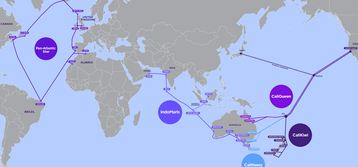
The firm recently announced plans for two landings in Tasmania. The CaliNewy cable (California to Australia) will land in Bell Bay, while the IndoMaris cable (Oman to India to Australia) will land close to Burnie.
CaliNewy will reportedly link Tasmania to Wonthaggi outside Melbourne and Newcastle on the Australian mainland before running to Fiji.
IndoMaris will run from Burnie to Oman (Duqm) via mainland Australia (Portland, Eucla, the Eyre Peninsula, and Geraldton), the Cocos Islands, the Maldives (Male), and India (Mumbai).
Tasmania is currently the landing point for three cables: Telstra's Bass Strait-1 and 2 cables and Basslink Telecoms' Basslink system, landing in Boat Harbour, Four Mile Bluff, and Stanley, respectively. All three systems are more than 20 years old.
Energy Estate this month signed a Memorandum of Understanding (MoU) with the H2U Group to co-develop energy and infrastructure precincts in Tasmania, which will host "data centers and other energy-intensive industries," with an initial focus on the Bell Bay port. H2U Group recently signed its own MoU with TasPorts to explore the development of a large-scale green hydrogen and ammonia production and export facility within the Bell Bay port precinct.
Details on the planned cable capacities, landing stations, and data centers weren’t shared. How the projects will be funded also hasn't been shared.
Founded in 2018, Energy Estate has been involved with some 1.24GW of utility-scale renewable energy development projects, including multiple wind and solar projects across Australia. It set up a digital unit last year with the aim of colocating data centers with its energy projects.
"Regions rising – this is what drives our team at Energy Estate. We are committed to delivering enduring regional economic growth and bringing data to the power represents an immediate and realisable opportunity for regional communities in Australia and New Zealand, " Simon Currie, co-founder of Energy Estate, said last year.
"Green data centers will be the anchor tenants for clean infrastructure and industrial estates – attracting manufacturing, renewable fuels, and other industries into our region and helping to sustainably decarbonise our existing critical industries such as resources and agriculture,"
Energy Estate said the hub in Bell Bay will be the first of the three sites the company is targeting in Tasmania.
The company said it is actively developing energy and infrastructure precincts to support data centers across Australia, New Zealand, and the US. These include Hunter in New South Wales and Bass Coast and Portland in Victoria, Australia; Waikato, Manawatu, and South Canterbury in New Zealand; and the Central Valley in California.
On its website, Energy Estate also lists plans for the Cali Queen and CaliKiwi systems linking California to Australia and New Zealand, respectively, via Hawaii and Fiji. In the Atlantic, it hopes to develop a system known as the Pan-Atlantic Star that would link Europe, Africa, South America, and North America.
In the US, the cable systems would land at the San Luis Industrial Complex, a planned solar and hydrogen plant in California the company acquired earlier this year.




Comments